Will Forma replace Revit? Autodesk's plan
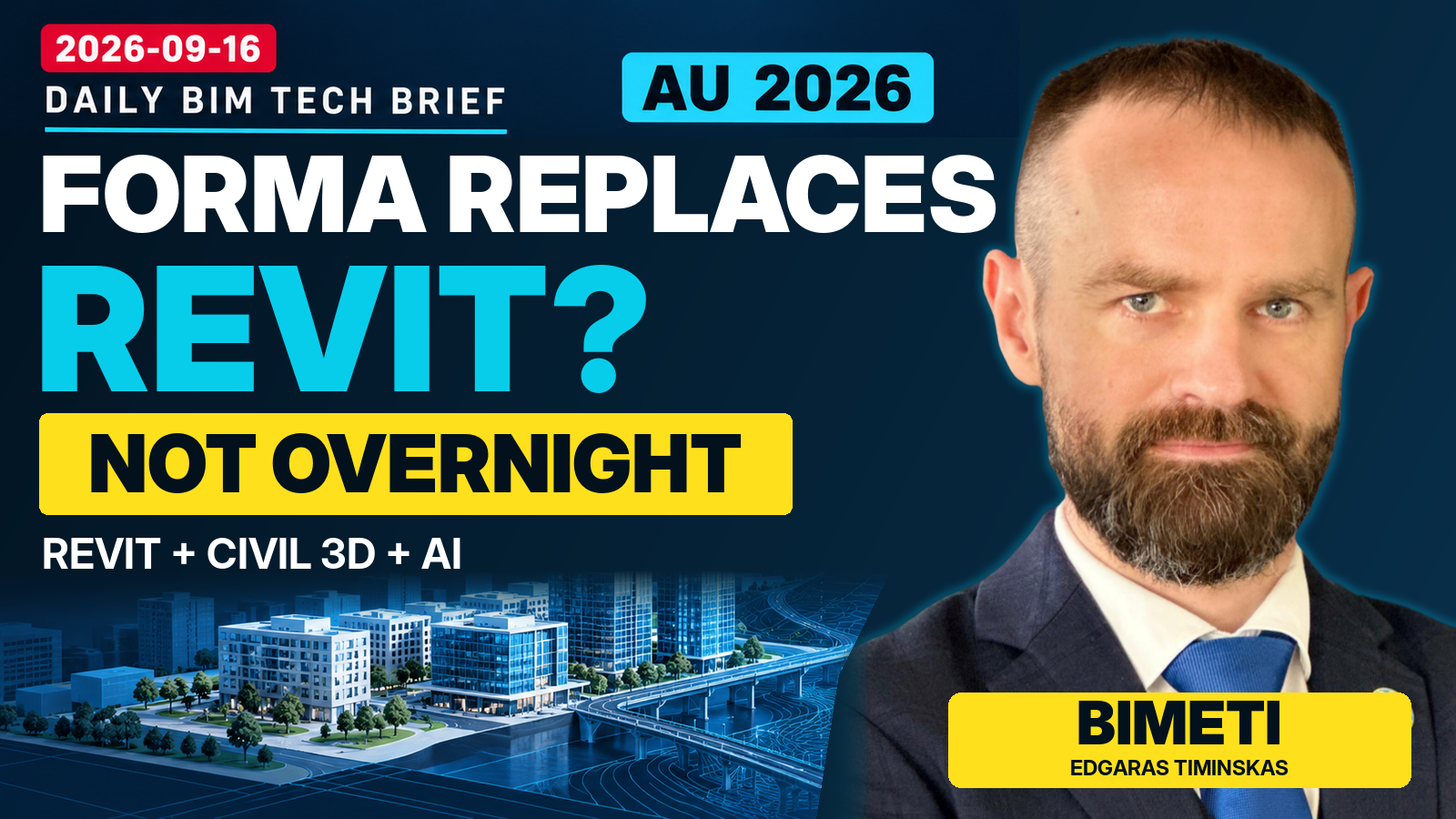
Edition: 16 September 2026 · Category: BIM News
This is an archived English edition. The briefing below preserves the original episode’s reporting and analysis, with paragraph headings added for reading. Words such as “today”, “planned” and “upcoming” refer to the edition date, not the website publication date. Product status, prices and deadlines should be checked again before a new decision.
The edition’s main signal. Announcements from the first day of Autodesk University have provided the clearest platform direction yet. Over time, more design, analysis, coordination and documentation work currently done in Revit will move directly into Forma. This is not an announcement that Revit is being discontinued suddenly. Autodesk also says it will continue investing in Revit, while the newly presented capabilities range from available now to beta, Tech Preview, planned and demonstrated only.
First news item
Autodesk has officially confirmed the long-term Revit and Forma direction.
Fact. On September 15, Autodesk stated that more of the design, analysis, coordination and documentation work performed in Revit today will eventually happen directly in Forma. Revit will continue to advance and connect more deeply with Forma. A forced sudden transition is not planned.
For a BIM manager, this is a platform architecture signal, not an instruction to migrate today. Create a process matrix covering the authoritative Revit function, the complementary Forma function, the exchange method, product status and validation evidence. Do not change the BIM execution plan, Revit templates or contractual deliverables until a real workflow has been tested.
Second news item
Civil 3D will become another Forma Connected Client, but the first stage is a Tech Preview.
Fact. The first stage introduces reference-based interoperability with Forma and Revit. Civil 3D will be able to display planning and building designs as context, while its information contributes to the shared project context. Autodesk is also developing a unified geolocation engine for Forma, Revit and Civil 3D.
The key limitation is that reference visibility is not bidirectional object editing or a semantically equivalent round trip. A Tech Preview test must check coordinate systems, elevations, units, True North, control points, model version and object identity. Open the same project in all three systems and compare the result against independent known control points.
Third news item
Forma Street Design has been introduced, but the product is still in development.
Fact. The cloud solution is intended for early street-option design in real-world context. It uses parametric geometry and supports synchronized plan and profile views, lanes, intersections and vehicle swept-path analysis powered by Autodesk Vehicle Tracking. The result is intended to move into Civil 3D. At present, users can only join the waitlist for a closed beta, and Autodesk explicitly says this is not a finished product.
An important detail is that AI is not used in the street-design workflow itself. AI is used only for visualization in Forma Board. The beta should therefore be assessed on parametric geometry accuracy, option comparison and the Civil 3D handoff, not on presentation quality. Test alignments, curve radii, lane widths, grades, assemblies, subassemblies, coordinates and change history.
Fourth news item
Revit and Forma AI workflows are moving from advice toward actions on the model and documentation.
Fact. Autodesk presented Revit workflows that can autocomplete room elements, optimize annotations and automate documentation across multiple views, while leaving review and acceptance to the human professional. In Forma Site Design, Autodesk Assistant will be able to answer natural-language questions about a site. Building Layout Explorer can generate and compare multifamily layouts against a client's unit mix.
The risk is that the general AU announcement does not provide the same availability, region or licensing status for every capability. Before any pilot, check the documentation, product status, supported objects and data handling separately for each function. Compare the AI result with a Revit schedule, the approved room program and issued drawings. Clicking Accept should represent evidenced professional review, not automatic trust.
Fifth news item
Forma Data Management is beginning to control access and review using metadata.
Fact. Smart Controls can use metadata such as approval status to manage access automatically. Autodesk Assistant will be able to search inside drawings, while Drawing Change Analysis highlights meaningful differences between revisions. Drawing Compliance Review, planned for early next year, will evaluate drawing packages against building codes, design standards and owner requirements, while professional review remains part of the process.
An ISO 19650 workflow must define which metadata controls access, who can change it, and how an automated observation becomes an issue, a decision and an approved change. An incorrect approval state in an automated system can distribute unapproved information faster than a manual process.
Sixth news item
Construction capabilities were announced at several different maturity levels.
Fact. Forma Bid is available in beta to eligible Forma for Preconstruction or BuildingConnected Pro subscribers. AI-powered insights are now appearing in Project Home within Forma Build. Workflow Studio supports building and testing approval workflows. On mobile, Daily Log Agent converts a superintendent's spoken update into a structured daily log. Autodesk is also expanding specialized agents for document search, submittal review and bid-proposal processing.
A pilot must distinguish an automatically prepared draft from a contractual record. Check speech recognition, date, time, location, responsible person, attachments and human approval. A daily log must not become official simply because the generated text sounds fluent.
Seventh news item
Tandem is being connected with Forma, FlexSim and MaintainX to form an operational action chain.
Fact. Autodesk University showed an AI-powered Tandem and Forma integration that can use BIM and manufacturing data as the basis of a shared digital twin. Autodesk announced a Tandem and FlexSim integration for process simulation. In a MaintainX demonstration, an asset operating outside its normal range initiates a maintenance workflow.
Interpretation. The digital twin is moving from passive asset viewing toward simulation and work initiation. However, the words showing, announced and available describe different product states. Require traceability from the sensor reading to the asset identifier, rule, simulation version, work order, technician decision and closure record.
Eighth news item
AI Transparency Cards are now available through Autodesk Assistant.
Fact. As of this week, users can ask in natural language what data an AI feature processes, which safeguards and human oversight apply, what its limitations are, and which underlying model it uses. The answer identifies the relevant AI Transparency Card. Autodesk also states that training datasets for certain features may include aggregated and de-identified elements of customer content.
Before allowing AI to process a client's project, save the card for that specific function and review data handling, customer choices, model provider and limitations. A general Autodesk trust statement is not permission to use confidential data with every feature.
Analysis and practical implications
Daily analysis. Autodesk has announced the direction, but BIM managers now need hybrid architecture rather than a migration program.
The emerging system has four layers. Revit and Civil 3D remain detailed-design environments. Forma becomes the shared data and process layer. Autodesk Assistant and specialized agents operate with project context. Tandem carries information into an operational digital twin.
The main opportunity is that project context, coordinates, decisions and approvals can move across the asset lifecycle without being recreated at every stage. The main risk is treating a marketing diagram as an architecture that works in production today.
Recommended actions. First, create a register with the states available, beta, Tech Preview, planned, demonstrated and long-term direction. Second, identify which system is authoritative for geometry, parameters, documents, issues and approval status at every stage. Third, prepare one reference Revit, Forma and Civil 3D project with known coordinates and control objects. Fourth, validate every transfer by object count, identity, class, properties, units, coordinates and version. Fifth, require dry-run, a change diff, human approval, audit and rollback for AI functions. Sixth, change BIM execution plans, templates and contractual requirements only after a documented pilot.
For teaching, students can assign one Autodesk University capability to the correct product state, map its data chain, design a validation test and explain which output may become an authoritative BIM record.
The edition’s signal. The Forma direction is now clear, but the immediate competence is not moving away from Revit. It is safely managing a hybrid of Revit, Civil 3D, Forma, AI agents and the operational digital twin.
Original edition sources
These direct links were cited in the original scheduled brief. The scheduled message was retrieved in full on 25 October 2026; this recovery is not a claim of a fresh product test or new source validation.
- https://adsknews.autodesk.com/en/news/autodesk-forma-ai-aec-connected-workflows-2026/ - https://www.autodesk.com/blogs/aec/2026/09/15/civil-3d-the-next-forma-connected-client/ - https://blogs.autodesk.com/forma/2026/09/15/introducing-autodesk-forma-street-design/ - https://adsknews.autodesk.com/en/news/autodesk-connected-operations-au-2026/ - https://adsknews.autodesk.com/en/news/autodesk-assistant-ai-transparency-cards-2026/
Watch the original edition
https://www.youtube.com/watch?v=55i33QYxin0
The original dated thumbnail is retained where available. Original per-topic artwork was not recovered for this legacy edition; no replacement artwork is represented as an original.
Watch the original BIMETI Daily BIM Tech Brief — 16 September 2026. Archived edition; review the cited sources for details and later updates.