openBIM meets AI: a finalist is not a standard
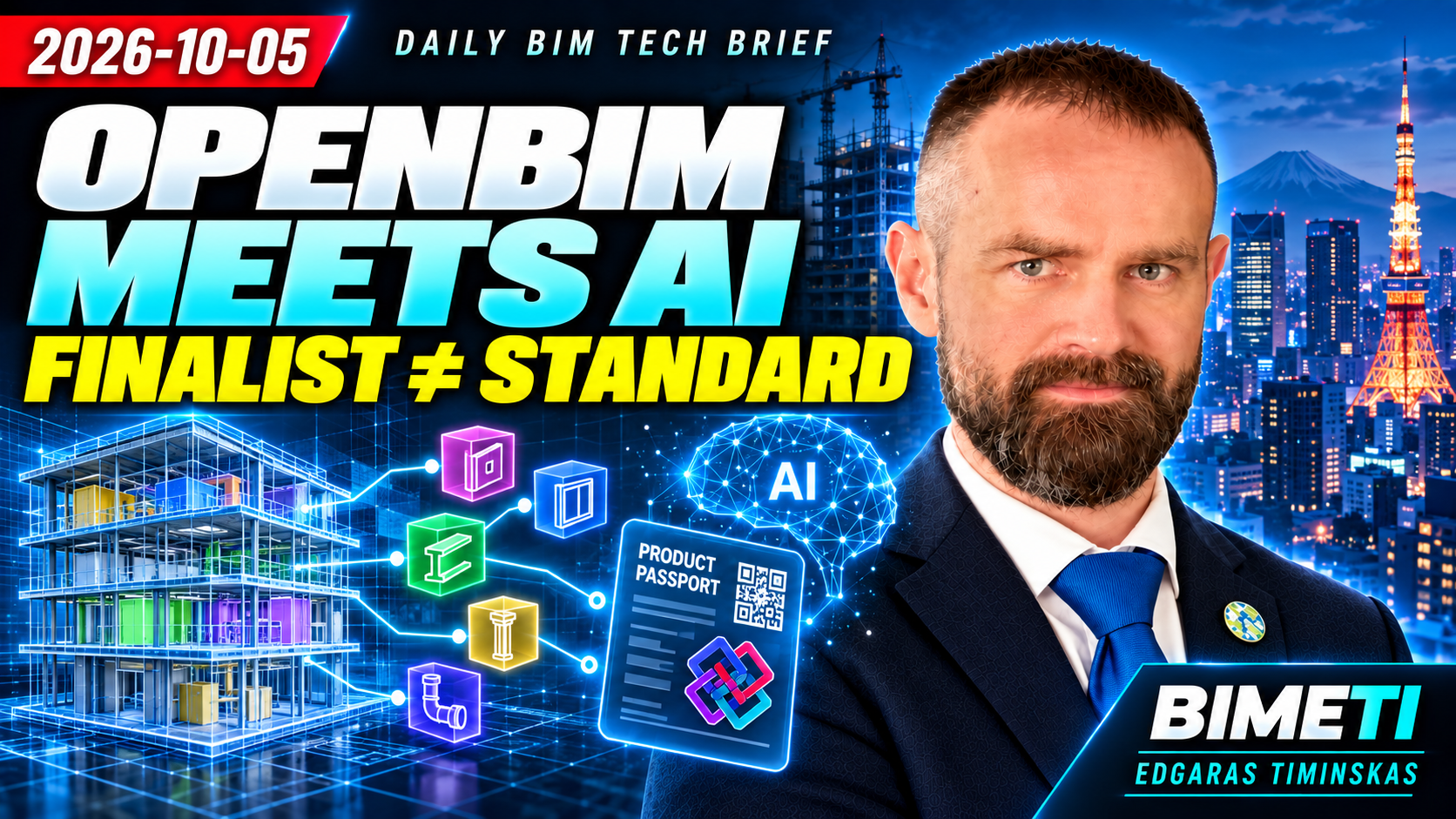
Edition: 5 October 2026 · Category: BIM News
This archive article preserves the English content of the original dated Daily BIM Tech Brief. Product availability, deadlines, research status and recommendations describe that edition—not a fresh assessment today. Underlying source dates differ from the edition date; supplier claims and research results remain attributed, not independent product tests.
Hello, and welcome to the October fifth Daily BIM Tech Brief. Today’s central theme is traceability. The value of AEC data is moving beyond the isolated model toward a reliable chain that connects a physical product, an open model, a common data environment process, and the real asset. But an award finalist, an industry consultation, or a planned delegated act is not yet a standard or a certified production result.
Visual archive note: no original per-topic video artwork was recovered for this edition. The original thumbnail and source video are retained; no substitute illustrations have been invented.
Tokyo Summit and the openBIM Awards
Our first story is the buildingSMART International Summit, which begins in Tokyo tomorrow and runs from October sixth to eighth. On October seventh, twenty-two openBIM Awards finalists across seven categories will present to an international jury. The winners will be announced on October eighth. The finalists include the use of IFC four point three across infrastructure portfolios, IFC as an asset information model, openBIM digital twins, IFC-based life-cycle assessment, and implementation of IFC four point three alignment geometry.
The practical distinction matters. An awards programme shows where the industry is experimenting and delivering value, but it is not a software certification scheme. Finalist status confirms selection, not universal interoperability, performance, or economic benefit. Watch for evidence behind the presentations: actual exchange tests, the IFC version, information requirements, software builds, and documented error limits. For education, this is a useful exercise in separating a compelling demonstration from a standardised method and from certified software behaviour.
Sources retained from the original edition: - https://www.buildingsmart.org/buildingsmart-international-announces-finalists-for-the-2026-openbim-awards/ - https://www.buildingsmart.org/event/buildingsmart-international-summit-tokyo-2026/
Agentic openBIM: interfaces are not guarantees
Our second story is the visible arrival of agentic openBIM. The technology finalists include Qonic Agentic 4D, The Semantic Bridge, and the usIFC MCP server. Student research includes large-language-model repair of IFC information quality, an IFC graph viewer, an IFC language server, and IFC-to-STEP integration.
This points to a shift from artificial intelligence that only summarises documents toward tool-using agents that query, check, or transform structured AEC data. Yet an MCP server is an interface, not a quality guarantee. An IFC file repaired by a large language model may be syntactically valid and still be semantically wrong. A safe AI and openBIM pilot should therefore start read-only, use a reference IFC model, run deterministic validation, show a change comparison, require human approval, preserve an audit trail, and support recovery. In teaching, assess not only the agent’s answer but also the selected IFC object, property, relationship, source version, and explanation of any error.
Sources retained from the original edition: - https://www.buildingsmart.org/buildingsmart-international-announces-finalists-for-the-2026-openbim-awards/
The Digital Product Passport identity problem
Our third story is the European Union’s Digital Product Passport. The registry infrastructure is operating, while construction-material rules are still being prepared. The European Commission says the registry framework was established in July and the registry became operational on July twentieth. The Construction Products Regulation is one of the separate legal bases through which product-passport requirements can be introduced. The Commission’s indicative timeline places delegated acts for construction materials and Digital Product Passport service providers in the second quarter of twenty twenty-seven. The timeline is explicitly indicative and depends on formal publication.
BIM teams should not pretend that the final construction-product passport schema is already known. They can, however, prepare for the identity and provenance problem. A physical product may need links to manufacturer data, a product or batch identifier, a BIM object, an IFC GlobalId, delivery, installation location, and an operations record. A useful first step is to select one product group, such as doors or structural steel, and create a pilot data map. Separate product type, individual instance, and batch. Do not reuse one identifier for every layer. Record the source, timestamp, responsible party, and version. Until the delegated act is published, label proposed fields as proposed rather than mandatory.
Sources retained from the original edition: - https://single-market-economy.ec.europa.eu/single-market/digital-product-passport_en
Procore sandbox outbound network changes
Our fourth story is an operational warning from Procore. On September thirtieth, Procore announced that sandbox outbound traffic will move behind centralised egress infrastructure on October twenty-seventh. URLs, endpoints, credentials, and inbound access will not change, and no downtime is expected. However, ERP connectors, webhook receivers, and other integrations that only allow Procore’s legacy static egress IP addresses may fail. Procore recommends domain-based allow-listing.
This is not only a network-administration issue. A common data environment may look healthy in the user interface while a background transfer has already stopped. A missing webhook may mean a network-policy failure, not that nothing happened. Before October twenty-seventh, inventory connections initiated by Procore, test sandbox ERP and webhook flows, implement delivery acknowledgements and timeouts, and prevent a failed integration from publishing stale state as new. Domain allow-listing should be combined with TLS, authentication, and least privilege, not treated as the sole security control.
Sources retained from the original edition: - https://status.procore.com/
Leica X-PAD and field evidence
Our fifth story is Leica X-PAD, which connects BIM data, augmented-reality guidance, and image-based measurement. Leica Geosystems introduced the X-PAD portfolio and the GS11 GNSS smart antenna. Field teams can work with two-dimensional, three-dimensional, map, and site views that include BIM data. They can use live-view guidance to navigate to points, check captured work before leaving the site, and measure difficult-to-reach points from images. X-PAD Fusion extends the workflow into the office, while GeoCloud supports data exchange. Availability in twenty twenty-six is limited to selected countries, with broader availability planned for twenty twenty-seven.
An augmented overlay can reduce repeat visits, but a visually convincing match is not proof of survey accuracy. A pilot should record the coordinate reference system, geoid, correction source, antenna height, image and point provenance, and the versions of the instrument and software. Control points and safety-critical elements should be checked independently. In education, students can compare the same point in GNSS, image measurement, and BIM coordinates, then explain the residual difference.
Sources retained from the original edition: - https://leica-geosystems.com/en-sg/about-us/news-room/news-overview/2026/09/leica-x-pad-portfolio-gs11-gnss-smart-antenna
Skovsporet construction printing
Our sixth story comes from Denmark, where a thirty-six-apartment, three-dimensionally printed student village has been completed. Skovsporet contains six buildings and a total of one thousand six hundred and fifty square metres. According to the technology supplier, the walls were printed on site using one BOD3 system operated by a three-person crew. Printing one six-apartment building took five working days. The reported building cost was one thousand eight hundred and eighty euros per square metre, excluding design, engineering, utility connections, site works, and landscaping. The project team also reports the use of a lower-carbon cement.
This is an important scale signal, but it is not a universal benchmark for the economics of construction printing. Evaluation must separate printing time from the total construction programme, the wall system from the complete building, a material carbon claim from whole-life carbon, and direct building cost from total project cost. The BIM process must cover design-to-production geometry, tool paths, openings, embedded components, tolerances, and verification of the as-printed result.
Sources retained from the original edition: - https://cobod.com/europes-largest-3d-printed-project-completed-below-denmarks-social-housing-cost-cap/ - https://www.saga.dk/news/europ
DTERBIM digital-renovation consultation
Our seventh story is the DTERBIM consultation on digital renovation. The European Commission’s BUILD UP platform announced a consultation for professionals in architecture, engineering, construction, building management, energy, public administration, research, technology, and finance. The responses are intended to shape an openBIM-based ecosystem for more circular, energy-efficient, and data-driven renovation. This is a consultation, not a released or certified toolset.
Digital renovation is constrained by more than software. Teams must reconcile the reliability of existing-condition data, energy information, material-reuse records, access rights, and accountability for decisions. Survey responses and pilots should name specific barriers: scan accuracy, missing asset identifiers, the cost of model updates, data licences, personal data, and portability between common data environments. For lecturers, this is an opportunity to ask students to define renovation information requirements instead of producing only an attractive existing-conditions model.
Sources retained from the original edition: - https://build-up.ec.europa.eu/ro/node/69523
Analysis and practical actions
Now for today’s analysis: from a BIM object to a physical product passport.
These stories share an identity and evidence problem. IFC and openBIM can transfer structured information. A Digital Product Passport is intended to connect a physical product to legally defined data. GNSS, augmented reality, and image measurement connect the design to a real location. Three-dimensional printing turns model geometry into production instructions. Common data environment integrations transfer status between systems, and AI agents may query or change these links.
What has actually changed? The industry has not gained one universal AEC identifier. Instead, it is gaining more identity layers that must be linked reliably: a product-type identifier, a batch or serial number, an authoring-system element identifier, an IFC GlobalId, a document version in the common data environment, an installation location, an inspection record, and an operational asset identifier.
The opportunity is substantial. Product data can be reused for procurement, logistics, installation, the as-built model, life-cycle assessment, and operations. An AI agent can search for missing links or inconsistencies when it has a defined source version and constrained permissions. openBIM can become a neutral semantic layer between a manufacturer’s passport, a design authoring tool, and an asset-management platform.
The risks are equally concrete. The same identifier may be used incorrectly for a type, an instance, and a batch. A passport value may be copied into BIM and never updated. An IFC export may alter a class, unit, or relationship. An AI agent may repair a file without an auditable change list. An augmented-reality overlay may create false confidence in accuracy. Supplier cost or carbon claims may be compared with data that use different system boundaries. A missing webhook may leave the common data environment in a stale state. And an indicative European timeline may be mistaken for a final legal obligation.
For a BIM manager, the priority is no longer to add one more parameter. It is to govern the identity map, the authoritative source, and transitions between states. The common data environment must preserve not only a file, but also its relationship to a specific product version, model version, and inspection result. The BIM execution plan and information requirements should state who creates each identifier, who may change it, how duplicates are detected, and what happens when synchronisation fails.
There are five practical next steps. First, choose one product group and map identifiers for type, instance, batch, BIM, IFC, the common data environment, and facility management. Second, create a reference dataset of twenty objects with correct, missing, stale, and duplicated links. Third, test export, import, and API transfer against identifier, class, units, properties, version, and timestamp. Fourth, keep AI agents read-only at first, and allow writing only with a change comparison, human approval, audit, and recovery. Fifth, monitor the twenty twenty-seven delegated acts for construction-product passports separately, and do not change mandatory contractual fields solely because of an indicative timeline.
Today’s conclusion is simple. The maturity of AEC digitalisation will not be demonstrated by the number of objects or agents. It will be demonstrated by the ability to prove that a physical product, a model object, a document version, and an inspection record belong to the same traceable chain.
Watch the edition: https://www.youtube.com/watch?v=AIhcHRxOmHQ
Watch the original BIMETI Daily BIM Tech Brief — 5 October 2026. Archived edition; review the cited sources for details and later updates.