Why Construction AI Stalls Between Pilot and Production

Edition: 18 October 2026 · Category: BIM News
This archived edition adapts the 18 October Daily BIM Tech Brief. Its underlying stories were published on 13–16 October. Survey results, investment announcements and supplier performance statements are different forms of evidence and should not be treated as interchangeable proof of production readiness.
1. Count production outcomes, not pilots
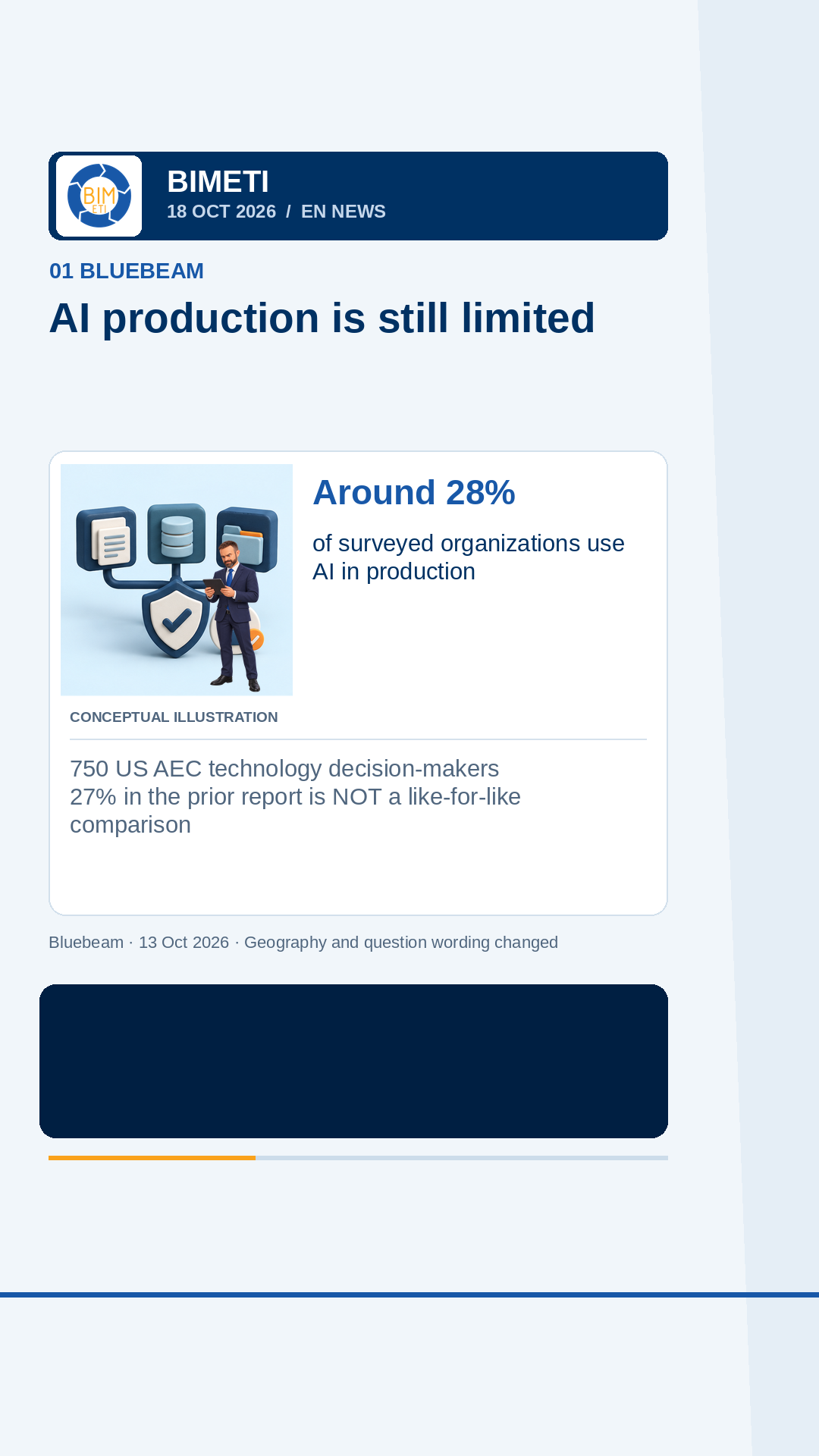
Bluebeam's 13 October technology outlook draws on 750 technology decision-makers in US AEC firms. Around 28% reported AI in production, 32% remained in pilots and 7% had embedded it across several core workflows. The previous report's 27% production figure is not a clean year-on-year comparison: geography and question wording changed.
Half cited implementation cost as a scaling barrier and 34% identified a lack of internal skills. Among organisations using AI, 64% reported improved cost predictability but only 17% reduced rework. These are survey responses, not an independently measured causal effect. Ask which workflow has an owner, approved inputs and a demonstrable reduction in errors.
Sources: https://press.bluebeam.com/2026/10/bluebeam-report-brings-constructions-ai-paradox-to-light-firms-running-ai-in-production-report-real-savings-but-only-28-have-gotten-that-far/ and https://www.bluebeam.com/resources/ebooks/aec-technology-outlook-report-2027/
2. Agentic business systems need explicit approval points

Access Construction announced Access Evo on 15 October across estimating, project management and construction ERP products. The supplier describes carrying context between activities, background tasks, compliance-document drafts and commercial-risk signals. Announced markets include the UK, Ireland, US and Australia, with final decisions retained by people. The supplier says customer data is not used to train external AI models.
Request a capability matrix, data-flow diagram, permissions, approval points and action logs. A draft prepared by an agent must not silently become approved project information. The announcement does not establish accuracy in an individual organisation or replace contractual data checks.
Source: Access-authored release — https://www.globenewswire.com/news-release/2026/10/15/3381703/0/en/access-construction-unveils-access-evo-bringing-agentic-ai-to-construction-software-and-turning-systems-of-record-into-a-system-of-action.html
3. Robotics investment increases the importance of model handover

ICON announced a $200 million Series D round on 13 October for manufacturing and deployment of Titan and Olympus robotic systems, a large Austin research facility and expansion. Its stated record of more than 270 homes and other structures is a company claim. Delivery and savings claims need comparable projects before they can serve as benchmarks.
Model-driven production requires a traceable chain from design geometry through robot paths and material parameters to tolerances and measured quality. Request open exports and an as-built feedback record rather than judging only a demonstration.
Source: ICON-authored release — https://www.globenewswire.com/news-release/2026/10/13/3379672/0/en/icon-raises-200m-series-d-to-transform-how-the-world-builds.html
4. Interior-finishing robots need whole-cycle tests

Reporting dated 15 October describes Origin emerging from stealth with $20 million in funding and its OG-one drywall-finishing robot. Compound application, sanding and priming are the stated initial tasks; pilots were planned in the US and Europe, with a target of 150 deployments by the end of 2027. Other tasks are future extensions, not established functions. The reported three-times-human-speed claim is the company's, not an independent trial.
A bounded pilot should measure preparation, replenishment, interventions and corrections as well as robot motion. Define finish-quality acceptance rules. A design model cannot replace perception of real site conditions.
Source, secondary reporting: https://theaiinsider.tech/2026/10/15/origin-raises-20m-to-scale-autonomous-construction-robots/
5. Financial-document AI needs an exception queue

reebuild announced €3 million in seed funding on 13 October to expand construction and real-estate document automation in Europe. Its described workflow extracts line items from invoices and related documents, matches records and prepares follow-up tasks while people retain approval. Supplier and investor savings figures are not independently audited.
Align cost codes, work packages and identifiers across estimating, ERP and the common data environment. Set confidence thresholds, preserve approval history and route ambiguous extractions into an exception queue. Faster reading is not a benefit if it merely moves work into another uncontrolled review backlog.
Sources: https://www.curiosityvc.com/post/reebuild-raises-eu3m-seed-round-to-build-ai-native-back-office-automation-for-construction-and-real-estate and https://tech.eu/2026/10/13/reebuild-secures-eur3m-to-automate-financial-workflows-in-construction
6. Revit chat control remains a governed experiment

Irwin & Company described a Revit integration under development and testing on 16 October. Intended tasks include element counts, rule-based colours and internal guidance search in a closed AWS environment. This was not a finished production service. Full Revit is required because Revit LT does not support the API.
Choose local, private-cloud or external models according to data sensitivity and audit needs. Define prohibited attributes, permissions and logs before testing. Model-changing commands must be approved, reversible and tried on a separate copy first.
Source: developer account — https://note.com/irwinandco/n/nb6a8d4fa8089?hl=en
Practical takeaway
Production readiness means controlled sources, owners, stable identifiers, approvals, exception handling and rollback—not just a convincing answer. Evaluate the full process and keep professional responsibility visible. No hands-on product test or independent benchmark is claimed in this archived brief.
Watch the edition: https://www.youtube.com/watch?v=JfdBQGDajoo
Visuals: Original rendered story cards from this edition’s video-derived cover package are reused here. They contain conceptual AI illustrations, not product screenshots.
Watch the original BIMETI Daily BIM Tech Brief — 18 October 2026. Archived edition; review the cited sources for details and later updates.