Motif Design: Is AI Agent BIM Ready for Revit Workflows?
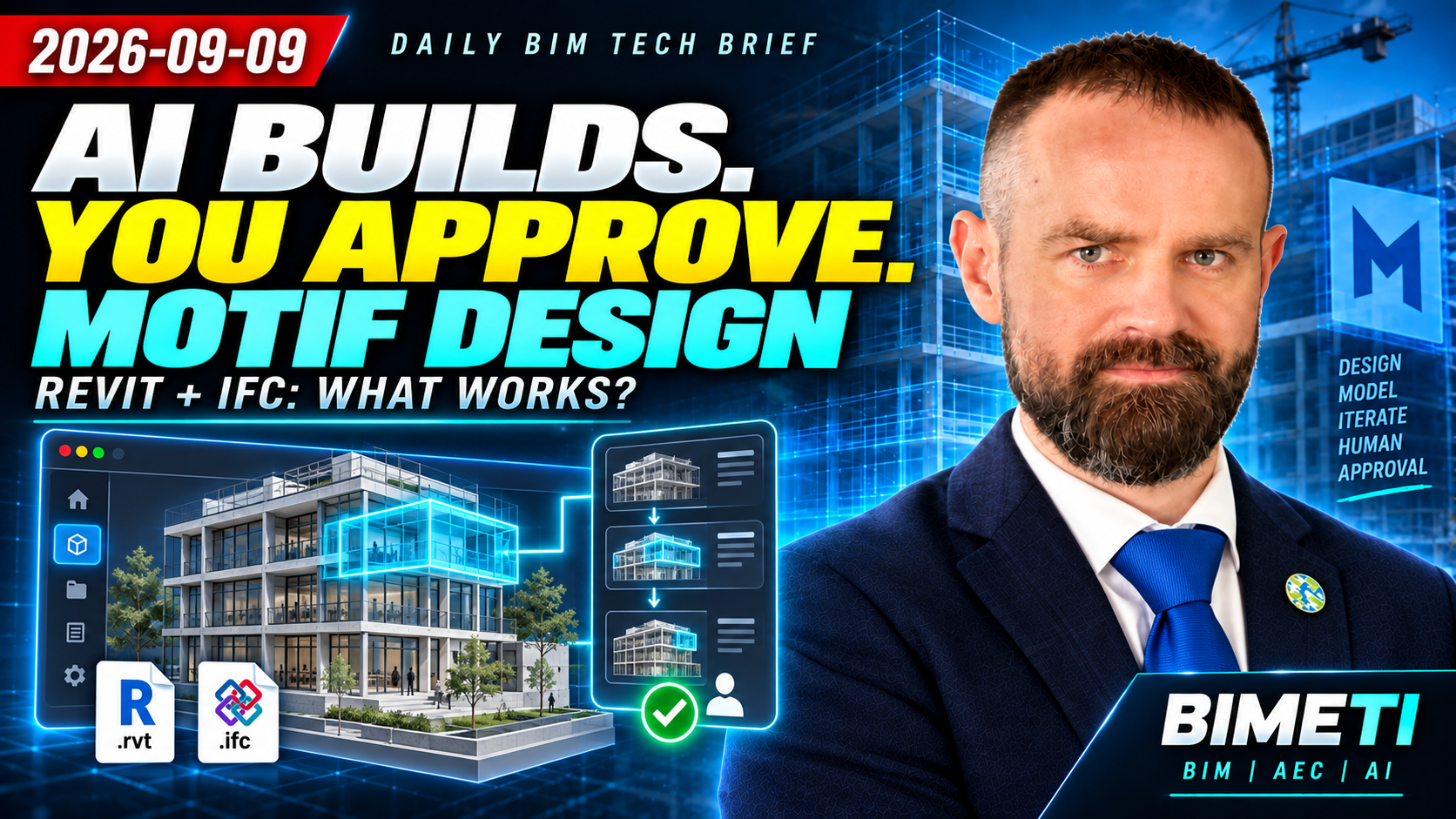
Edition: 9 September 2026 · Category: BIM News
This is an archived English edition. The briefing below preserves the original episode’s reporting and analysis, with paragraph headings added for reading. Words such as “today”, “planned” and “upcoming” refer to the edition date, not the website publication date. Product status, prices and deadlines should be checked again before a new decision.
The edition’s signal: Motif Design, introduced on September 8, moves the AI agent from a BIM add-on into the architecture of the model itself. It is a serious signal for the Revit market, but the launch release is not yet a universal alternative to established BIM processes or accumulated Revit libraries.
News item one
Motif Design is now officially available.
Fact. Motif describes the platform as a browser-based parametric and associative BIM environment in which people and AI agents model, evaluate, and document buildings together. It combines modeling and documentation in one shared project workspace.
Why it matters. This is one of the clearest attempts to create not a separate BIM assistant but a new authoring environment in which the agent is part of the system from the beginning.
Action. Treat the product as a new technology architecture, but do not declare it a Revit replacement without comparing real project outputs, compatibility, and final documents.
Practical implication. A browser architecture may reduce installation and workstation administration and involve more project participants in model review. However, browser access alone does not resolve information accountability, offline work, data residency, or long-term archiving. A BIM manager must distinguish convenient collaboration from the contractual common data environment process.
News item two
AI agents work on the same live model as designers.
Fact. Agents can answer questions about the model, modify it, test requirements, and generate models, objects, and documents. Motif says every action is logged and reversible. Example tasks include checking a design brief, finding doors without a fire rating, and selecting products that match requirements.
Why it matters. Agentic BIM is moving from advice to controlled action in a shared data model. An audit trail and reversibility become safety foundations rather than optional features.
Action. For a pilot, require the object identifier, original and modified states, agent identity, applied rule, timestamp, human approval, and proof of rollback. Test not only whether an Undo command exists, but whether dependent views, tags, schedules, and documents are restored correctly.
For education, this changes what should be assessed. A student should submit not only the agent-generated model but also the original requirement, the agent action history, their independent validation, and an explanation of why the result was accepted or rejected. This evaluates professional judgment rather than the ability to write an impressive prompt.
News item three
Revit, Rhino, and IFC are intended to provide live project context.
Fact. Motif claims live streaming of Revit and Rhino models without manual exporting, together with IFC import and export. The independent AEC Magazine review reports that IFC geometry and parameters can be modified in Motif and published back to IFC. A Revit plug-in transmits geometry and data, then streams later changes as deltas.
Risk. A model being visible in the platform does not prove a semantically equivalent round trip. Convincing geometry may lose a GlobalId, class, property set, unit, coordinate, material, or relationship with the original Revit family.
Action. Use benchmark Revit and IFC models. Check GlobalId values, classes, property sets, units, shared coordinates, elevation, True North, materials, quantities, and change differences. Compare the output in at least two independent IFC validation tools.
Important boundary. At launch, the Revit connection primarily provides context and delta updates, but full geometry write-back to Revit is not available. A pilot must therefore state which model is authoritative and where the final change is made.
News item four
The platform is presented as open and extensible.
Fact. Its data model is described as queryable. Firms can add object types, properties, and behaviors and save agent workflows as reusable skills. Motif also says its contracts prohibit third-party AI providers from training on customer projects.
Why it matters. Company BIM standards, parameter rules, and checking processes could become an executable organizational knowledge layer. Yet the marketing word open is not a substitute for a technical interoperability contract.
Action. Before adoption, request API and export documentation, data-region details, the subprocessors list, retention periods, audit-log coverage, the permissions model, incident procedures, and data-exit terms.
News item five
The shared model is designed for parallel work by people and agents.
Fact. The platform uses real-time collaboration, change history, and conflict detection rather than Revit-style locking of operations. Motif claims distributed computing, GPU processing, and loading only the required parts of a project. Several agents can work in parallel while people continue to use the model.
Interpretation. This may reduce waiting and allow several schemes to be checked simultaneously, but it increases the need to manage conflicts, dependencies, and the authoritative model state clearly.
Action. Run human and agent changes against the same element set at the same time. Test merge, conflict, approval, and rollback behavior, as well as how changes propagate into sheets, quantities, and IFC exports.
News item six
The launch release still has important Revit and Autodesk Construction Cloud gaps.
Fact. AEC Magazine reports that the September 8 release does not include full Revit geometry write-back, one-click migration of Revit family libraries, deeper Autodesk Construction Cloud integration, complete BIM object coverage, end-user Level of Detail authoring, or productized headless operation. The speed demonstrations shown to the publication were accelerated, and no formal comparative benchmark was supplied. Broader API, software development kit, and agent-building capabilities are planned for later stages.
Why it matters. For many practices, value is stored not only in RVT models but in families, templates, Dynamo processes, Autodesk Construction Cloud permissions, and documentation standards. Importing a model does not migrate those assets.
Action. Replace the vendor demonstration with an organizational benchmark model and contractual deliverables. Create a capability matrix with four states: available now, available with limitations, roadmap, and unsupported. Do not treat the roadmap as a commitment.
News item seven
Pricing is tied to active use and AI credits.
Fact. Motif Design Business starts at 150 US dollars per active user per month on an annual plan. An active user is a logged-in user who consumes AI credits during that month. Unused credits do not roll over. Motif Design currently has no free trial, although the separate Motif Review product offers a fourteen-day trial.
Action. Calculate total cost of ownership together with AI consumption, retained Revit or Rhino licensing, migration, training, integrations, and the period of running two processes. Do not compare only the monthly license price.
Analysis and practical implications
Daily analysis. Agent-native BIM changes the architecture of responsibility, not merely the buttons.
The traditional chain is: a person, a BIM team, an add-on or script, and a model change. The emerging chain is: a human objective, an agent plan, parallel model actions, automated validation, conflict resolution, and human approval.
The greatest opportunity is that the agent can understand model semantics, requirements, and history and can perform verifiable actions instead of only explaining them. This could accelerate test fits, interior options, requirement checks, product selection, and documentation preparation.
The greatest risk is that an error can propagate faster in the live shared model. A reversible action does not help if nobody knows which version was authoritative, what requirement the agent interpreted, whether an exported IFC remained semantically equivalent, or whether a generated document satisfies the contract.
For a pilot, select one small test zone. First, load an approved Revit and IFC baseline. Second, prepare ten precise tasks covering missing parameters, the room program, door requirements, one option, and one documentation sheet. Third, inspect the input, difference, log, approval, and rollback for every agent action. Fourth, compare the exported IFC with the baseline for geometry, identifiers, classes, properties, coordinates, and quantities. Fifth, determine what actually returns to Revit and what remains only in Motif. Sixth, measure not demonstration speed but total time to an approved deliverable, human corrections, incorrect results, and cost.
For teaching, use a comparative assignment. Students complete the same small project through a traditional BIM process and with an agent. Assess not the images but the decision logic, model information, change traceability, IFC round trip, and the ability to explain agent errors.
The edition’s signal. Motif Design is an important milestone for the agentic BIM market, but production value will be demonstrated not by an agent's ability to modify a model, but by dependable Revit and IFC round trips, an audit trail, conflict control, and approved final deliverables.
Original edition sources
These direct links were cited in the original scheduled brief. The scheduled message was retrieved in full on 25 October 2026; this recovery is not a claim of a fresh product test or new source validation.
- https://www.businesswire.com/news/home/20260908595059/en/Motif-Introduces-Motif-Design-The-First-Agent-Native-Building-Design-Software-Platform - https://www.motif.io/ - https://aecmag.com/bim/inside-motif-the-agent-native-bim-platform/ - https://www.motif.io/pricing
Watch the original edition
https://www.youtube.com/watch?v=guyk8raL7_8
The original dated thumbnail is retained where available. Original per-topic artwork was not recovered for this legacy edition; no replacement artwork is represented as an original.
Watch the original BIMETI Daily BIM Tech Brief — 9 September 2026. Archived edition; review the cited sources for details and later updates.