Issue Before RFI: Faster BIM Decisions Without Losing Control
Edition: 10 September 2026 · Category: BIM News
This is an archived English edition. The briefing below preserves the original episode’s reporting and analysis, with paragraph headings added for reading. Words such as “today”, “planned” and “upcoming” refer to the edition date, not the website publication date. Product status, prices and deadlines should be checked again before a new decision.
The edition’s signal is a process published by Autodesk in which Barton Malow separates an early project question from a formal request for information. Issues are used for collaboration and accountability, while the RFI is retained where a formal record is required. For a BIM manager, this is about managing information states, not merely software functions.
News item one
Autodesk has published a new Barton Malow case on Lean communication.
Fact. In a 47-minute webinar published on September 10, Barton Malow's design management team explains how Issues are used to surface questions earlier and manage collaboration across owners, designers, contractors and trade partners.
Why it matters. The change is not a new software feature. It is a documented process model. An organization can use the same technology either as an unmanaged stream of comments or as a controlled decision system.
Action. In one project, measure how many questions are resolved before becoming formal RFIs and whether decision time is reduced. The source is Autodesk Construction Cloud.
News item two
Not every project question needs to begin as an RFI.
Fact. In the case description, Issues are used to raise questions earlier, while the role of RFIs is preserved when formal documentation is required.
Interpretation. This is a two-stage communication model. An operational question is first handled in a faster channel, but a decision with contractual significance is formalized.
Action. Define clear criteria for when an Issue can be closed, when it must be escalated to an RFI and who makes that decision. A more convenient channel cannot replace the contractual process.
News item three
An early question needs an owner and a realistic due date.
Fact. The Barton Malow process emphasizes clear ownership and realistic deadlines.
Why it matters. Without an accountable person and a date, an Issue becomes another unmanaged comment list. The speed of creating records has no value if a question has no decision owner.
Action. Make the owner, due date, location or model element, discipline, priority and closure evidence mandatory fields. Align the deadline with the complexity of the decision instead of applying the same date to every record.
News item four
All project parties need consistent rules of engagement.
Fact. The case highlights common rules of engagement across owners, designers, contractors and trade partners.
Interpretation. A common platform does not remove different interpretations of the words answered, closed or approved. Teams may see the same record while understanding its state differently.
Action. Define states, response periods, escalation, authority to close and the formalization threshold in the BIM execution plan or project information protocol. Training should use concrete scenarios, not only a list of status names.
News item five
Issues, meetings and project governance need to operate as one chain.
Fact. Autodesk says Barton Malow connects Issues, meetings and project governance so that decisions and context remain in one place. Autodesk's learning material also confirms that actions in Build meeting minutes can be linked directly to RFIs, submittals and Issues.
Action. Do not copy the question into meeting minutes as disconnected free text. Link it to the authoritative record and preserve the decision date, participants and attachments. A meeting should extend the history of the question, not create a second source of truth.
News item six
RFIs remain necessary for formal documentation.
Fact. The published process does not eliminate RFIs. It explicitly preserves their role when a formal project record is needed.
Risk. If too many questions remain only in the Issues channel, it may be unclear which response changed the design, cost, schedule or responsibility.
Action. When escalating to an RFI, transfer more than the latest comment. Include a concise problem statement, the related model and document versions, previous decisions and the exact unresolved question.
News item seven
A Lean outcome should be measured rather than assumed.
Fact. Autodesk's publication presents practical lessons about collaboration and accountability, but the page does not provide comparative performance indicators or results from an independent study.
Action. Before and after the pilot, measure question age, time to first response, reopenings, conversion to RFI, overdue decisions and changes after approval. Only then can the team distinguish a real Lean improvement from a larger volume of recorded activity.
Analysis and practical implications
Daily analysis. Issue before RFI is an architecture of information states.
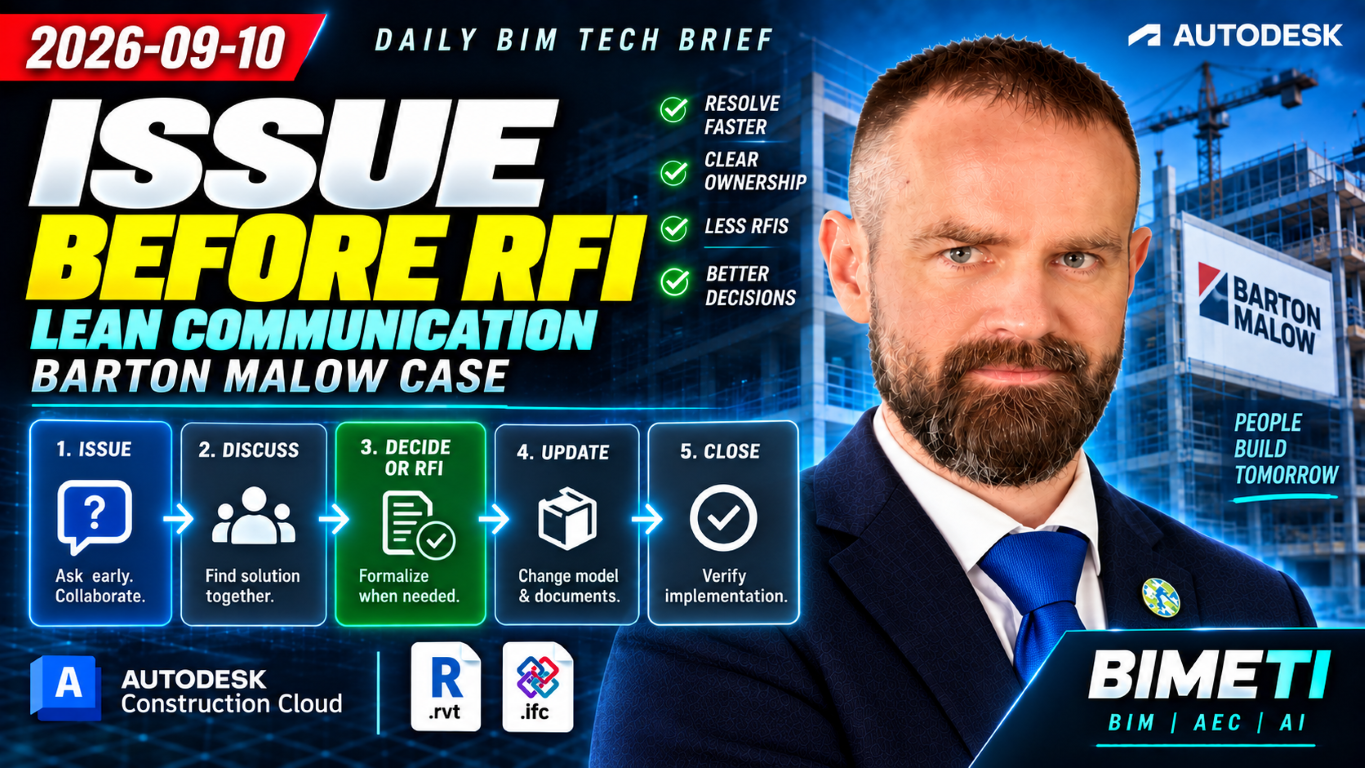
The recommended chain begins with an observation. It is registered as an Issue, an accountable person is assigned, and a technical discussion follows. The outcome is either a decision or a formal RFI. After the formal response, the model and documents are changed, the change is verified, and only then is the question closed.
The main opportunity is to resolve coordination, constructability and missing-information questions early, before they become an expensive formal process. An Issue can be linked to a specific location, model element, view or meeting, so context is less likely to become fragmented across email. The operational channel also makes it faster to establish whether a problem genuinely needs a contractual response.
However, speed must not remove governance. The first risk is an unclear boundary between advice and a contractual instruction. A project participant may begin work from a comment even though the response has not been approved by the authorized person. The second risk is a duplicated Issue and RFI with different states. One record may be closed while the other still awaits an answer.
The third risk is that a question is closed even though the authoritative Revit model, IFC file, drawing or specification has not been changed. The fourth is the loss of version context. A screenshot may show a problem but cannot prove which model or document version was being reviewed. The fifth is a system filled with low-priority records that hide critical decisions. The sixth is a dashboard that shows activity without demonstrating whether a decision was correct and implemented.
A practical pilot can run for four weeks and cover one area of multidisciplinary coordination. Step one is to define five Issue categories and three mandatory conditions for escalation to an RFI. These are a potential change to cost or schedule, a conflict between contractual documents and a change to the design solution.
Step two is to require a location or element, source version, owner, due date, priority and closure evidence for every record. If the question relates to a model, preserve the model and version identifiers rather than only a screenshot.
Step three is to link the meeting minutes to the existing record. Create a new question only when it is genuinely a separate problem. This reduces parallel histories and maintains one point of accountability.
Step four is to verify after the answer whether the Revit model, IFC file, drawing or specification was changed and whether the new version was published to the common data environment. An answer is not completed work until its effect on authoritative project information has been demonstrated.
Step five is to separate three queues on the weekly dashboard: records awaiting an answer, records awaiting formalization, and records awaiting a model or document change. One combined Open count does not show where the process is blocked.
Add alerts for overdue records, closure without a linked change, and an RFI response that refers to an obsolete model version.
Step six is to compare decision time, RFI volume, repeated questions, late design changes and records closed without the required information update. A positive outcome is not simply fewer RFIs. Formal RFIs should also be better framed, while critical decisions must not disappear inside an informal channel.
From an ISO 19650 perspective, an Issue is not automatically authoritative information. The project must define which state is work in progress, which is shared for coordination, and which approved document or model version becomes the contractual record. A link to an object improves traceability, but it does not replace review, authorization and common data environment status rules.
For university teaching, use a practical simulation. Student teams receive a model discrepancy and must formulate it clearly as an Issue, assign an owner and due date, and decide whether an RFI is required. After the response, they must change the model and show the version in which the decision was implemented. Assessment should focus on clarity, version traceability, the justification for escalation and the demonstrated change in the final model, not the number of comments.
The edition’s signal. A good digital process does not formalize every question immediately, but it leaves no decision without an owner, a due date, an authoritative version and a clear threshold for becoming a formal record.
Original edition sources
These direct links were cited in the original scheduled brief. The scheduled message was retrieved in full on 25 October 2026; this recovery is not a claim of a fresh product test or new source validation.
- https://construction.autodesk.com/resources/source-acc-webinars/beyond-rfis-how-barton-malow-uses-issues-to-support-lean-construction-workflows-2/ - https://www.autodesk.com/learn/ondemand/course/construction-project-management/unit/1AvYkpc3Hj0xp6CZ10E6SL
Watch the original edition
https://www.youtube.com/watch?v=S3pslFxtQbc
The original dated thumbnail is retained where available. Original per-topic artwork was not recovered for this legacy edition; no replacement artwork is represented as an original.
Watch the original BIMETI Daily BIM Tech Brief — 10 September 2026. Archived edition; review the cited sources for details and later updates.