AI checks links between models and documents

Edition: 7 October 2026 · Category: BIM News
This archive article preserves the English content of the original dated Daily BIM Tech Brief. Product availability, deadlines, research status and recommendations describe that edition—not a fresh assessment today. Underlying source dates differ from the edition date; supplier claims and research results remain attributed, not independent product tests.
The main signal today is that artificial intelligence tools are starting to review relationships, not just individual files. They are comparing BIM models, drawings, specifications, quantities and rules. The value is a traceable discrepancy. The risk is a convincing statement that has not been verified well enough.
Visual archive note: the original video used the same cross-source QA artwork for its first five topics, with separate digital-twin and robotics illustrations for the final two. This article retains that original mapping rather than inventing replacement artwork.
Structured AI links models and documents

Structured AI has brought model and document quality review into one workflow. On October sixth, AEC Magazine reported that the platform can examine an IFC or native Revit model alongside PDF drawings, specifications, codes, schedules and project manuals. The vendor says an issue found on a drawing can be linked to the affected model element, and the Revit add-in can open that finding beside the model. A proposed change is applied only after an engineer approves it. The platform also claims integrations with Autodesk Construction Cloud Issues and Bluebeam Studio.
This is an important shift from separate model and document checks toward cross-checking project evidence. However, the library of more than nine hundred checks, the accuracy claims and the time savings are vendor-reported capabilities, not independently verified performance across every discipline. A BIM manager should prepare a small benchmark package with known correct and incorrect cases: a Revit or IFC model, issued drawings, a specification and a schedule. Measure false positives, missed discrepancies, the accuracy of model-element links, version traceability and the human approval record, not only the number of findings.
Sources retained from the original edition: - https://aecmag.com/bim/qa-qc-platform-links-bim-models-and-drawing-sets/ - https://docs.getstructured.ai/
Volve orchestrates tendering checks

Volve is applying AI orchestration to tendering and preconstruction checks. A user can assign a multi-step task in natural language, such as comparing quantities in a specification with drawings and an IFC model. The company says the system plans the steps, runs the checks, verifies the result and presents its sources. Volve published its own announcement on September twenty-fourth, and AEC Magazine covered the capability on October sixth.
In bid preparation, AI is moving from document search toward multi-source analysis and task sequencing. But a statement that a system verified its own output is not the same as independent deterministic verification. For a pilot, choose one bounded quantity group and approve the correct answer in advance. Assess source retrieval, unit normalization, model-version selection, calculation, exception handling and the final human conclusion separately. Pricing or bid decisions should not be automated without a clearly accountable professional.
Sources retained from the original edition: - https://www.volvetech.com/insights/volve-brings-ai-into-expert-tender-work - https://aecmag.com/construction/volve-ai-to-help-automate-tendering-and-pre-construction-tasks/
Vectorworks 2027 intelligent import

Vectorworks 2027 expands intelligent import from Revit and DWG. Revit families and instances can be imported as new Vectorworks dynamic object styles. DXF and DWG dynamic blocks can also become dynamic objects instead of only groups or symbols. In a development article published on October sixth, Vectorworks described this as an effort to bring across more than basic linework. The English edition is available now, while localized versions are being released from October through the first quarter of next year.
Editable intelligent content may reduce the manual rebuilding of families and blocks, but an imported object does not automatically become semantically equivalent to the original. Types, parameters, classification, materials, connectors and behavior can change. Before making the function part of a standard workflow, test ten representative Revit families and DWG dynamic blocks. Compare geometry, type counts, parameters, units, classification, two-dimensional and three-dimensional representation, and the subsequent IFC export. Also confirm availability in the required local-language edition.
Sources retained from the original edition: - https://www.vectorworks.net/en-US/newsroom/vectorworks-2027-development - https://app-help.vectorworks.net/2027/eng/VW2027_Guide/LandingPage/New_features.htm - https://www.vectorworks.net/en-US/newsroom/vectorworks-2027
Autodesk AEC leadership and platform direction

Diana Colella will lead Autodesk's AEC business. Autodesk announced on October sixth that Colella has become executive vice president and will succeed Amy Bunszel. Bunszel will remain through November second to support the transition. Autodesk says Colella will advance the Forma strategy, continue to evolve Revit and Civil 3D, and connect their desktop workflows more closely with Forma.
This is a strategy and leadership announcement, not a new product feature. It confirms that Autodesk's AEC direction continues to center on the Forma industry cloud, shared project context and artificial intelligence. Organizations should watch for concrete evidence rather than executive language: data model access, changes to Revit and Civil 3D workflows, licensing, regional availability, export and an exit strategy. For teaching, it is a useful platform-economics case: product dependency, data dependency and workflow dependency are not the same thing.
Sources retained from the original edition: - https://adsknews.autodesk.com/en/news/autodesk-names-diana-colella-to-lead-aec/
Archicad 28 AI Visualizer retirement

AI Visualizer 1.0 in Archicad 28 will be retired on October ninth. Graphisoft's support center says that through October eighth this version accepts English prompts only because a third-party translation service has been discontinued. AI Visualizer 3.0 remains available in Archicad 29 and Archicad 30.
This is a practical reminder that a cloud AI add-on can stop operating while the host BIM application remains in use. The AI feature lifecycle, language support and third-party dependencies must be managed separately from the authoring application version. Before October ninth, finish required tests and preserve final images, prompts and settings records. If the process matters, test migration to Archicad 29 or 30, but do not assume the newer version produces an identical result.
Sources retained from the original edition: - https://support.graphisoft.com/hc/en-us/articles/50301051449361-AI-Visualizer-does-not-accept-non-English-prompts-in-Archicad-28
LiveTwin infrastructure digital twins
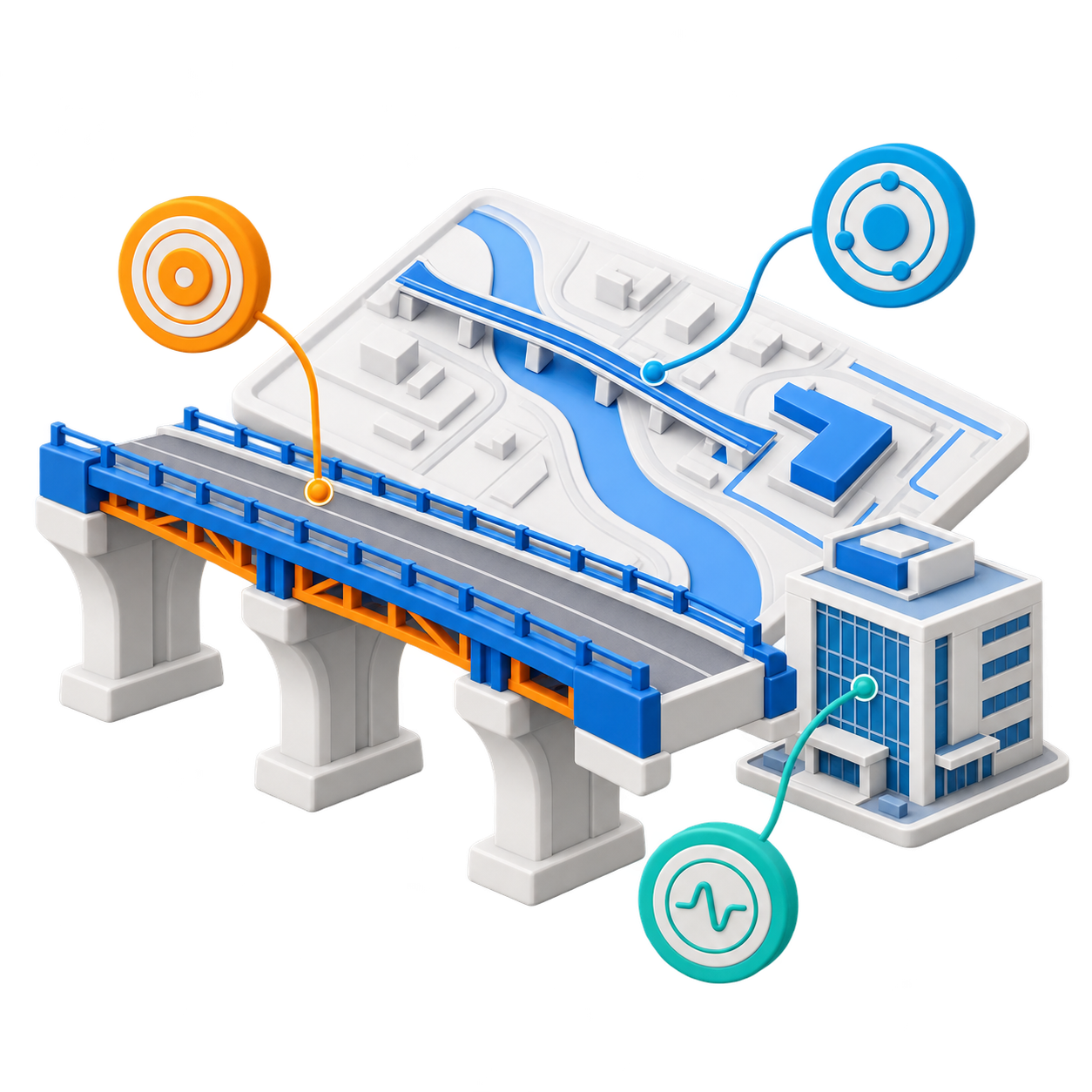
Michael Baker International has launched the LiveTwin infrastructure digital twin platform. On October first, the company said LiveTwin brings BIM, GIS, reality capture, Internet of Things data, enterprise systems and workflows into a common operational view. The company reports that early adopters use it across more than fourteen hundred facilities in the United States, covering more than thirty million square feet. These are vendor-provided figures, and the announcement does not include an independent audit of the outcomes.
The market continues to move from three-dimensional visualization toward data federation and operational decisions. The critical question is not whether BIM and GIS appear in one interface. It is whether authoritative identifiers, time, provenance, permissions and feedback to source systems are preserved. For a pilot, select one asset class and one decision, such as maintenance prioritization. Record the relationships among the BIM object, GIS feature, sensor and asset-register identifiers, as well as update frequency, system of record and disconnection behavior.
Sources retained from the original edition: - https://mbakerintl.com/news_articles/michael-baker-international-launches-livetwin-an-open-ai-native-digital-twin-platform-built-for-the-future-of-critical-infrastructure/
MVP-SLAM and CORNAV robotics research

two new research papers use plans and schedules for construction-site robot localization and safety. A preprint posted on September thirtieth describes MVP-SLAM, a system with two opposite-facing fisheye cameras and an inertial measurement unit. It matches detected walls to a floor plan while operating online. On the Hilti-Trimble SLAM Challenge 2026 data, the authors report a localization mean root mean square error of zero point two nine meters and a SLAM error of zero point two four meters. The system ranked second of twenty-two teams in localization and fifth of sixty-two in SLAM.
A second preprint, CORNAV, was posted on October second. It uses two-dimensional CAD drawings, the construction schedule and safety constraints to plan a robot route. In the authors' tests, blueprint grounding raised task success from thirteen percent to seventy-two point two percent, while schedule-aware constraints eliminated hard-zone violations.
Together, the studies suggest that design and construction-management information can become an active localization and safety layer for robots. But they are preprints, not peer-reviewed production systems. In research or education pilots, treat the plan as versioned sensor context, not immutable truth. Test differences between as-planned and as-built conditions, moved obstacles, an outdated schedule, a mislabeled exclusion zone, loss of connectivity and a safe stop. Human supervision and physical safety systems remain essential.
Sources retained from the original edition: - https://arxiv.org/abs/2609.39596 - https://arxiv.org/abs/2610.03622
Analysis and practical actions
Today's analysis is about the new object of AI quality assurance. It is not the file. It is the relationship between sources.
For years, BIM quality control has been separated by file type. A model is checked in a model checker, a PDF is marked up in a review tool, a specification is read separately, and quantities are compared in a spreadsheet. The Structured AI and Volve announcements point to a different architecture. The system first creates links among documents, model elements, requirements and calculations, and then searches for contradictions.
What has actually changed? One instruction can now initiate a multi-source review and return a finding to the working environment, such as a Revit element or a CDE issue. What has not been proven is that a general AI system can reliably replace a discipline reviewer. Production value depends on five controls: the correct source version, a stable object identifier, a clear rule, a reproducible calculation and an accountable professional decision.
The opportunity is substantial. Cross-source QA can identify earlier that a specification class conflicts with a drawing tag, a schedule quantity disagrees with an IFC object set, or a changed model element has not reached the issued sheet. The same relationship layer can feed CDE issues, the project risk register, tender clarifications and teaching exercises.
The risks are systemic as well. AI may select the wrong model issue. It may connect the same item incorrectly across files. A PDF table may be read inaccurately. Units may be converted silently. A code excerpt may be applied to the wrong jurisdiction. And a cited source may prove only where text was found, not that the conclusion is correct. Automated correction increases the risk further, so proposal, approval, write-back and audit should remain separate stages.
A safer sequence begins by freezing the model and document issue. Next, define a deterministic rule or an approved question. The AI returns a finding with sources. A specialist validates the element and document links, makes a decision, creates a CDE issue or controlled change, reruns the check and retains the audit record.
For BIM managers, governance must cover more than tool access. It must define source authority, identifier mapping, query scope, approval rights and performance metrics. A CDE should not treat an AI finding as a closed issue. Draft or needs review is a safer initial status.
Students should learn not only to run an AI check but also to create a benchmark answer, calculate precision and recall, trace a claim to an object and document version, and explain why one source is authoritative for a particular question.
Five practical next steps. First, choose one narrow cross-source case, such as checking a door fire rating across Revit, a schedule, a drawing and a specification. Second, create a small benchmark package with approved errors and correct cases, and freeze every file version. Third, measure source retrieval, object matching, rule execution, false positives, missed findings and professional corrections separately. Fourth, begin CDE integration with draft issues, and allow automatic model write-back only after a diff, human approval, audit and recovery test. Fifth, rerun the same benchmark after every tool, model or rule-set update as a regression test.
The conclusion today is simple. AI creates value in AEC quality assurance not when it gives a persuasive answer, but when it proves the link among the claim, the exact model element, the document location, the rule, the version and the accountable human decision.
Watch the edition: https://www.youtube.com/watch?v=pXzpBU5MRIE
Watch the original BIMETI Daily BIM Tech Brief — 7 October 2026. Archived edition; review the cited sources for details and later updates.