Trusted Digital Twins: From Visualisation to Audit

Edition: 16 October 2026 · Category: BIM News
This archived Daily BIM Tech Brief brings together six developments covered in the original 16 October edition. Announcement dates differ from the edition date. The practical recommendations are editorial analysis, not results from product testing.
A policy signal for faster permitting

At its October meeting, the European Council called for further measures to accelerate planning and permitting and reduce administrative burdens. The important distinction is between political direction and an adopted technical rule: the edition does not establish a new BIM mandate or a detailed digital-permitting regulation. For project teams, the useful question is whether subsequent proposals clarify digital submissions and machine-checkable information requirements. Faster administration still depends on unambiguous data and aligned classifications.
Source: European Council meeting, 15–16 October 2026 — https://www.consilium.europa.eu/en/meetings/european-council/2026/10/15-16/
ProjectSight links reduce friction—and change the risk

ProjectSight Web version 2026.19, released on 13 October, introduced an option to include a public download link in drawing notifications. The documented link expires after seven days and allows recipients to download without signing in; normal sign-in remains when the option is not selected. Convenience is not equivalent to named, auditable access. Before enabling such sharing, define permitted document types, sensitivity restrictions, responsible roles and evidence of transmission. Test revision handling in a controlled project rather than assuming the new access route is appropriate everywhere.
Source: Trimble release notes — https://help.trimble.com/doc/projectsight/projectsight/whats-new-in-projectsight/projectsight-release-notes-2026/whats-new-in-projectsight-october-2026/whats-new-for-projectsight-web-october-13-2026-version-2026.19
Digital-twin trust becomes an assessment question

A 7 October announcement presented Neuron Digital as the first recipient of the new BSI Kitemark for Digital Twins. The scheme was described as aligned with the ISO/IEC 30186:2025 maturity model, considering purpose, governance, lifecycle management, security and value. That is a certification result for one organisation within a defined scope—not approval of all digital-twin technology. Procurement teams should ask what is assessed, which system and use cases are covered, and how performance and ongoing governance are evidenced.
Sources: company announcement — https://voiceofasean.com/newsroom/neuron-digital-becomes-first-smart-technology-company-globally-to-achieve-bsi-kitemark-for-digital-twins/ ; ISO catalogue — https://www.iso.org/standard/53306.html
Infrastructure awards are case studies, not universal benchmarks

Bentley announced its 2026 Year in Infrastructure Awards winners on 7 October, covering twelve categories and more than 300 nominations from 53 countries. The projects illustrate connected information across disciplines and lifecycle stages. However, an award and a vendor’s interpretation do not establish an independently measured industry-wide productivity result. When applying a case-study lesson, ask for its baseline, measurement method and handover structure before predicting the same outcome on another project.
Sources: Bentley announcement — https://www.businesswire.com/news/home/20261007964087/en/Bentley-Systems-Announces-Winners-of-the-2026-Year-in-Infrastructure-Awards ; awards information — https://www.bentley.com/en/resources/yii-awards-2026/
Ask one useful question of the project archive
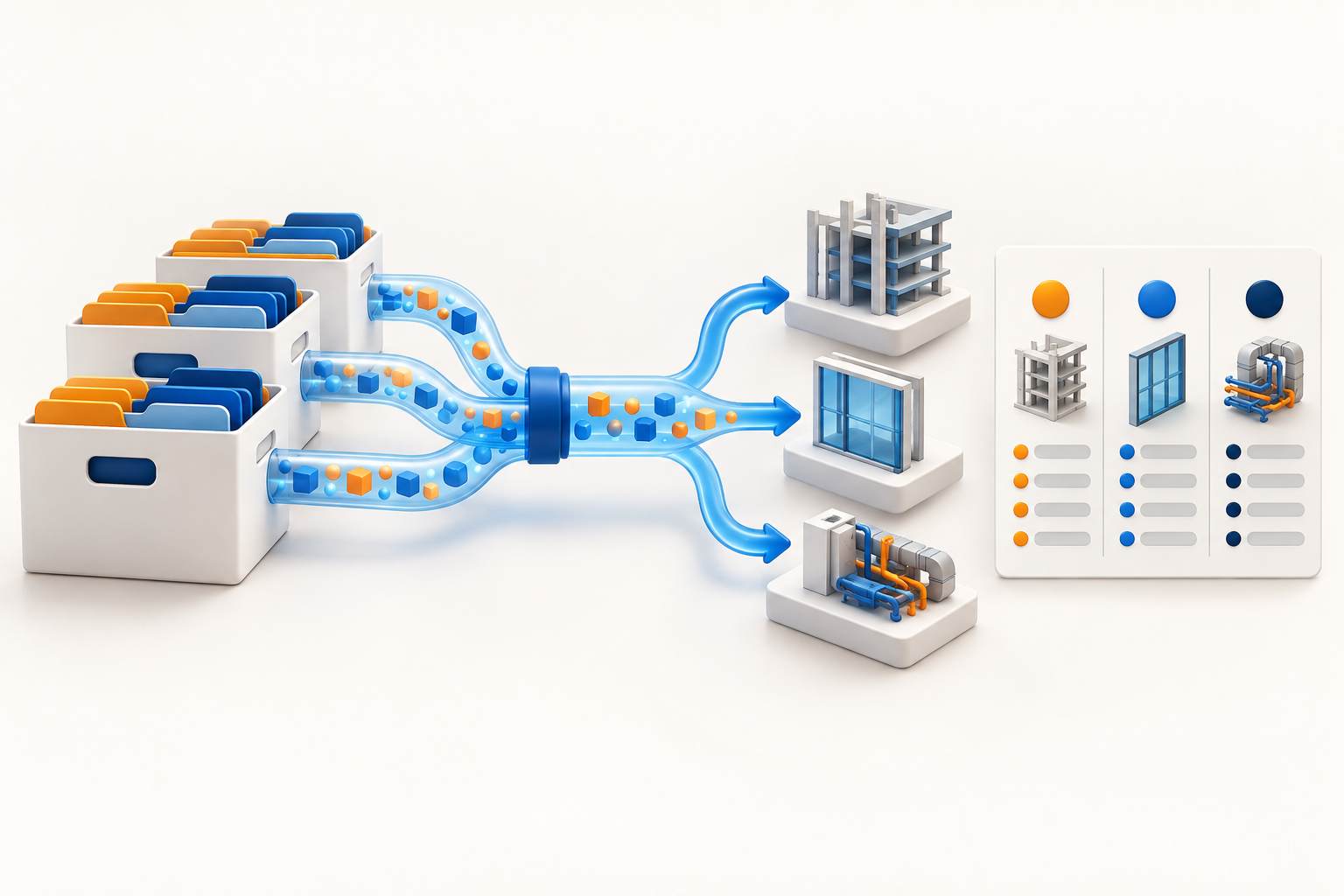
The original edition discusses Speckle’s archive-data methodology: begin with a recurring business question, identify the information needed to answer it and only then build a repeatable extraction pipeline. This is vendor editorial guidance, not an independently demonstrated product outcome. A manageable experiment could compare quantity changes across three completed projects, first checking consistent fields, classifications, versions and provenance. AI does not correct poorly structured history simply by processing it faster.
Source retained in the edition: Speckle’s editorial index — https://speckle.systems/blog/
Agentic BIM requires controlled write access

AEC Magazine’s September/October issue discusses agent-native modelling, Autodesk’s AI direction and Revit access through Model Context Protocol. Motif’s description of architects and AI agents working with the same model is product positioning, not proof of suitability for a critical project. Evaluate permissions, element-level change logs, human approval, rollback and open export before permitting an agent to alter real information. A demonstration should not replace an approved delivery process.
Sources: https://aecmag.com/technology/aec-magazine-september-october-2026-out/ and https://motif.io/
Practical takeaway
Trust needs evidence: the data version used, who could access it, what changed and who approved the result. Treat those records as deliverables alongside the model. The original conceptual AI illustrations accompany this archived edition; they are not product screenshots or verified project models.
Watch the edition: https://www.youtube.com/watch?v=jVrOZwR4R2A
Watch the original BIMETI Daily BIM Tech Brief — 16 October 2026. Archived edition; review the cited sources for details and later updates.