Shared Project Context: Forma + Civil 3D
Edition: 15 October 2026 · Category: BIM News
This archived Daily BIM Tech Brief covers six topics from the 15 October edition. The underlying announcements and research have their own dates. Recommendations below are editorial analysis, not product-test results. Conceptual illustrations are the original images prepared for this edition's video, not product screenshots.
Forma, Civil 3D and Revit move toward shared context

Autodesk's 14 October recap describes Civil 3D becoming a Forma Connected Client alongside Revit. Crucially, the first stage is a technology preview—not a fully bidirectional production chain. The direction is to reference planning and building context and contribute civil information back to the project environment, with more consistent geolocation across the applications. Forma Street Design remains in development with a closed-beta waitlist, while Building Layout Explorer is early research.
For a BIM manager, the useful next step is a maturity matrix: production, technology preview, beta, planned capability and research. Record whether each connection only displays information or can edit and write it back. Before relying on a workflow, verify coordinates, object identities, permissions, version relationships and rollback. A compelling demonstration does not establish contractual delivery readiness.
Source: Autodesk Forma, 14 October 2026 — https://blogs.autodesk.com/forma/2026/10/14/what-autodesk-forma-announced-au-2026/
Forma Board connects review with data management

The same Autodesk announcement describes Forma Board integration with Forma Data Management. Models, drawings and PDFs can be reviewed in one workspace, alternatives compared and comments or markups added, with Data Management issues visible in Board. AI visualisation supports concept imagery from a sketch or image.
The process boundary remains important: an idea, a technical issue, a decision and approved information are different records. In a pilot, check whether comments and issues remain associated with the correct model version after changes. Use AI imagery for communication, not as evidence that geometry, materials or regulatory compliance have been verified. The announcement is not a detailed specification of contractual approval or audit controls.
Source: Autodesk Forma, 14 October 2026 — https://blogs.autodesk.com/forma/2026/10/14/what-autodesk-forma-announced-au-2026/
Dalux 2026.6 links field capture and operations

The release hub lists Build 2026.6 on 1 October and FM 2026.6 on 29 September. The edition reports a SiteWalk coverage view, a recording limit extended to ten minutes and clearer reasons when processing fails. InfraField supports creating tasks or checklists from the map. Internal work-order messages in FM can include files and images that are not visible to an external supplier.
These changes connect location, capture, tasks and maintenance, but teams should test them with a small user group before broad deployment. Check coverage, mobile data use, location accuracy and attachment visibility for each role. Decide which attachments belong in the durable asset record and which are temporary internal communication; a convenient workflow is not a substitute for a retention and access policy.
Source: Dalux release hub, October 2026 — https://support.dalux.com/hc/en-us/articles/19497855907484-What-s-new-in-Dalux
Nemetschek's market signal is not an integration test

On 14 October, Nemetschek announced its placement in the Leaders category of IDC's Worldwide Construction Management Software 2026 vendor assessment. Its announcement highlights a portfolio spanning planning, BIM coordination, document collaboration, field data, commercial processes and operations, and reports a 24% research-and-development reinvestment rate.
This is a vendor announcement of a market assessment, not independent proof that every connection between group products works seamlessly. For procurement, ask for an integration map, data ownership terms, API information and an exit scenario. Test the actual proposed workflow with IFC, BCF, PDF, document metadata and asset information. Lifecycle coverage is useful only if information remains identifiable, transferable and governed.
Source: Nemetschek, 14 October 2026 — https://www.nemetschek.com/en/news-media/idc-marketscape-names-nemetschek-leader
BIM2RDT connects semantics and robot navigation

An October Automation in Construction study describes BIM2RDT, combining BIM geometry, ground-robot imagery and Internet of Things sensors into a robot-ready construction digital twin. Semantic-Gravity ICP uses language-model orientation priors for BIM families to assist point-cloud registration. The system also includes activity-aware navigation cost maps and links safety events back to IFC context.
The reported reduction of up to 97% in registration root mean square error applies to the study's difficult experimental scenes—not all construction sites. A pilot should separate the navigation model from contractual BIM, write events to a controlled copy, preserve model and sensor timestamps, and require human approval before route changes in critical zones. Research performance does not remove operational safety responsibility.
Source: Automation in Construction, October 2026, DOI 10.1016/j.autcon.2026.107134 — https://doi.org/10.1016/j.autcon.2026.107134
An OpenUSD operational twin remains a proof of concept
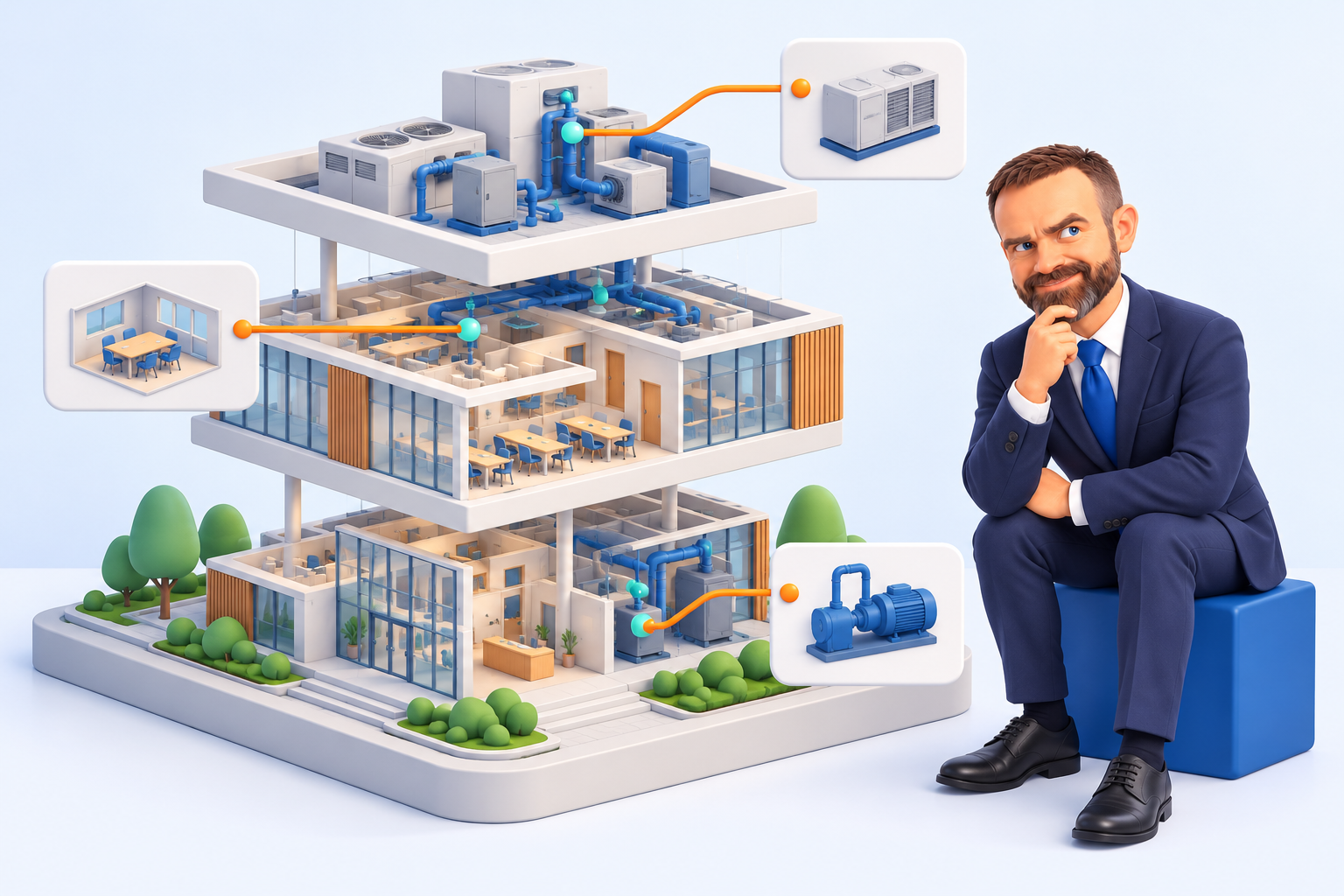
The ITcon study presents a five-layer architecture and an NVIDIA Omniverse Kit prototype for an academic building. It combines BIM spatial context, building-automation telemetry, equipment and room records, showing operational semantics, live data and historical trends in an OpenUSD scene.
This is a proof of concept, not a standardised replacement for IFC or a common data environment. A useful pilot needs an identity map between IFC, the building management system, the asset register and the USD scene. Assign an authoritative source to each attribute and retain provenance and timestamps. A visualisation scene should not quietly become the sole asset register without governance and versioning.
Source: ITcon, 2026, DOI 10.36680/j.itcon.2026.035 — https://www.itcon.org/paper/2026/35
Practical takeaway: visible is not authoritative
Shared context can reduce repeated site modelling and connect disciplines earlier. It also increases the need for stable identifiers, coordinates, semantic mappings, permission rules and clear responsibility. Start with one pilot: map authoritative sources, test identity through a real transfer, distinguish working comments from approved deliverables in the BIM execution plan, and require human approval, an audit trail and export recovery for automated connections. Integration becomes valuable when the team can explain which version governs, who owns it and how its origin can be reconstructed.
Watch the edition: https://www.youtube.com/watch?v=lA3lzEUmGhE
Watch the original BIMETI Daily BIM Tech Brief — 15 October 2026. Archived edition; review the cited sources for details and later updates.