Revizto 5.18 and the New CDE Decision Boundary
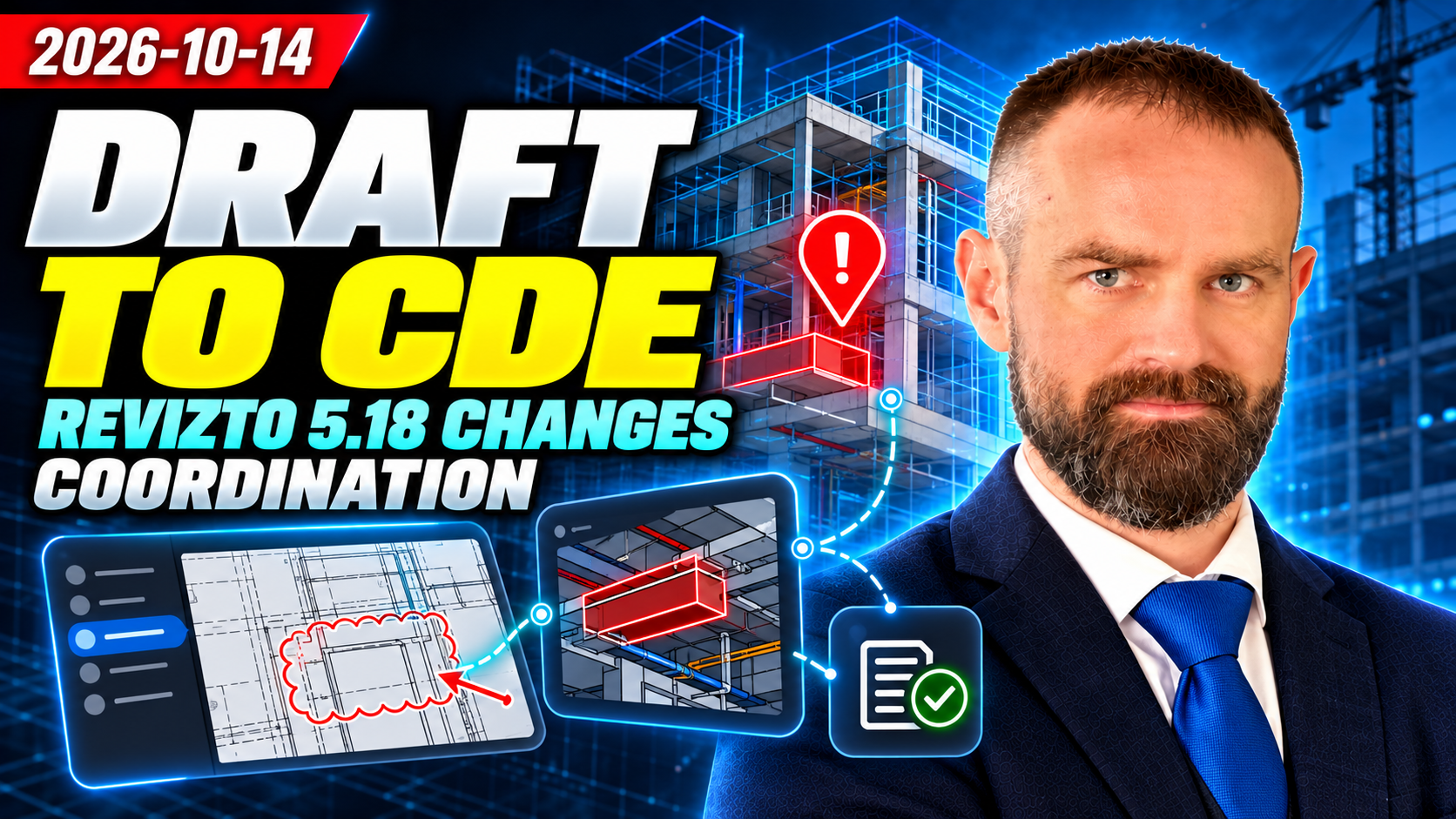
Edition: 14 October 2026 · Category: BIM News
This archived edition preserves the five stories and analysis from the original 14 October briefing. Event dates differ from the edition date; product status is described as reported then. Recommendations are editorial analysis, not evidence of product testing. The original conceptual video illustrations are not product screenshots.
Revizto 5.18: from private draft to official issue

Revizto released version 5.18 on October thirteenth. Its new Draft Mode lets users create private issue and markup drafts directly in two-dimensional drawings and three-dimensional models. Authors can refine an observation and decide later whether it should become a tracked project issue. Drafts are stored locally and remain invisible to the wider team until they are published.
This matters for more than user convenience. A coordination platform now has an intermediate state between personal investigation and a formal issue. That can reduce noise and duplication, but it also creates the risk that an important observation remains in a local draft. A BIM execution plan should therefore define when a draft must become an official record, who makes that decision, and how unpublished drafts are reviewed before a coordination meeting ends.
Revizto 5.18 also adds custom-property export and import through CSV files, together with redesigned two-dimensional navigation. The vendor says complex models load four times faster than in version 5.17, but the public announcement does not provide the test methodology. Teams should verify that claim with their own models. CSV exchanges should also start in a copy, with clearly defined editable fields, stable object identifiers, an audit trail, and a rollback plan.
Source retained in the original edition: https://revizto.com/resources/newsroom/company-news/revizto-5-18-draft-mode
Graphisoft clarifies AI availability and Archicad Max

The product pages published after the October thirteenth Graphisoft Ignite event make the company’s new AI and subscription model clearer. Archicad MCP is explicitly labelled beta. Graphisoft says it can connect artificial intelligence to project context, answer questions, perform updates, and make batch changes to a model. The company also introduced AI Assistant Spaces for document-based organizational knowledge and a new premium subscription called Archicad Max.
Archicad Max includes Archicad, BIMcloud SaaS, MEP Designer, every language version, a higher AI-credit allowance, and early access to Nemetschek Creator. Status matters here. Early access is not a mature commercial product, and Graphisoft says the commercial Creator release is planned for 2027. The meaningful update since the previous brief is therefore the clearer availability and commercial packaging, rather than another list of Archicad 30 features.
For BIM managers, agentic model work is becoming a separate layer of subscription value. Beta-stage automated changes should not become a production process without permissions, change logs, human approval, and rollback. The first trial should use a non-production file and an explicit list of permitted actions. When comparing Studio, Collaborate, and Max, assess not only price but the actual use of BIMcloud, MEP tools, regional libraries, AI credits, and future Creator access.
Source retained in the original edition: https://www.graphisoft.com/en-gb/plans-and-products/whats-new/
Blueprints AI still requires professional review

TechCrunch profiled Blueprints AI, a company selected for the 2026 Startup Battlefield 200. The company says it can generate architectural, structural, mechanical, electrical, plumbing, energy-compliance, fire-safety, and interior drawing sets from text, sketches, PDFs, CAD files, photographs, or point clouds.
The marketing hook suggests permit-ready drawings in minutes. The company’s own website uses the more careful phrase “toward code compliance” and states that a licensed architect or engineer must review and seal the final documents. No independent cross-jurisdiction accuracy study or analysis of plan-check rejection rates is publicly available.
The signal is still important. AI is moving from advice toward document production. Yet a generated sheet set is not confirmed compliance. Responsibility shifts toward requirement definition, source control, multidisciplinary coordination, exception handling, and professional review. Any evaluation should begin with a non-production project, a pre-defined control set, a record of every manual correction, and a firm rule against automatic submission to an authority.
Source retained in the original edition: https://techcrunch.com/2026/10/12/this-ai-startup-says-it-can-generate-permit-ready-blueprints-in-minutes/
Construction startup finalists show a workflow focus

Cemex Ventures and its partners announced the thirteen remaining finalists in the 2026 Construction Startup Competition. Eight will pitch in Las Vegas and five in Helsinki. The competition received a record 798 applications from 62 countries, 40.3 percent more than in 2025.
Jobsite productivity and building systems formed the largest category at 32.5 percent. Climate technology represented 22.8 percent, while preconstruction technology accounted for 21.7 percent. The finalists include machine-readable BIM and CAD compliance checking, links between four-dimensional BIM and 360-degree capture, robot-fleet orchestration, and three-dimensional road-condition analysis.
Finalist status does not prove product maturity. However, the application pattern is a useful market signal. Innovation is concentrating on narrow workflow links such as quantities, regulations, progress, logistics, and physical autonomy. For BIM managers, that means more integrations and more data contracts, not simply more interfaces. Evaluate these tools through their input requirements, open-format support, error detection, human oversight, and export options.
Source retained in the original edition: https://www.cemexventures.com/finalists-construction-startup-competition-2026/
Windows 11 support is an AEC workstation issue

Microsoft confirmed an important workstation deadline. Windows 11 version 24H2 Home and Pro reached end of updates on October thirteenth, and the October security package is the last one for those editions. Enterprise and Education remain supported until October twelfth, 2027. Microsoft recommends moving compatible Home and Pro devices to version 25H2 or 26H2.
This is not a BIM product announcement, but it directly affects workstations running Revit, Civil 3D, Navisworks, point-cloud applications, and visualization tools. A rushed operating-system upgrade can disrupt graphics drivers, licensing, or plug-ins. Staying behind creates a security exposure. Teams should inventory the exact edition and version, verify certified AEC configurations, and deploy the update first to a representative pilot workstation with a documented rollback plan.
Source retained in the original edition: https://learn.microsoft.com/en-us/windows/release-health/windows-message-center
The decision boundary inside the common data environment
Historically, a coordination observation often had only two outcomes. It became a formal issue, or it remained outside the platform in a PDF, notebook, screenshot, or private message. Revizto 5.18 introduces a middle state. The observation remains linked to a precise drawing or model location, but it is not yet part of the official project record.
Technically, this can shorten the path from an initial thought to a well-formed issue. During a review meeting, teams can capture raw observations, combine duplicates, add evidence, and publish only the items that require action. From a business perspective, this may reduce noise, mistaken assignments, and administration. But a locally stored draft is not yet shared evidence, a backup, or a contractual notice.
The biggest risk is an invisible queue. A critical issue may remain private and never enter the process for ownership, deadlines, and closure. Each organization also needs to test what happens when users change devices, restore profiles, or work offline. CSV property import creates another risk: without a stable identifier, type validation, and rollback, a bulk operation can corrupt project attributes at scale.
From an ISO 19650 perspective, a private draft should not be confused with shared or published information. Project rules should define the publication criterion, the beginning of official status, the accountable person, the deadline, and the audit record. Drafts can support working thought, but decision registers, approvals, and contractual notices must remain in a governed shared environment.
For the BIM manager, the task expands beyond issue classification to managing the transition from private observation to shared responsibility. This is also a useful teaching exercise. Students can first create drafts, then review, merge, and publish only the items that require formal action. The lesson is not how to press a button; it is how to manage the meaning and status of information.
Five practical next steps follow. First, define in a pilot project when a draft is published, rejected, or merged. Second, review unpublished drafts at the end of every coordination meeting and name the responsible person. Third, test draft persistence across device and profile changes. Fourth, test CSV imports in a copy and validate stable identifiers, data types, and editable fields. Fifth, after four weeks, compare the number of official issues, duplication, closure time, and lost observations.
Today’s signal is simple: a good common data environment does more than store official records. It clearly governs the moment when an individual thought becomes a team responsibility.
Watch the edition: https://www.youtube.com/watch?v=1T39UmLkC2A
Watch the original BIMETI Daily BIM Tech Brief — 14 October 2026. Archived edition; review the cited sources for details and later updates.