IFC Data Quality Beyond Filled Fields

Edition: 13 October 2026 · Category: BIM News
This archived edition preserves the original briefing and its practical analysis. Edition date and underlying announcement dates are different. Product status and reported figures reflect that dated source material, not fresh testing. Conceptual illustrations are original video artwork, not product screenshots.
Hexagon and Rocscience: an agreement, not a completed acquisition
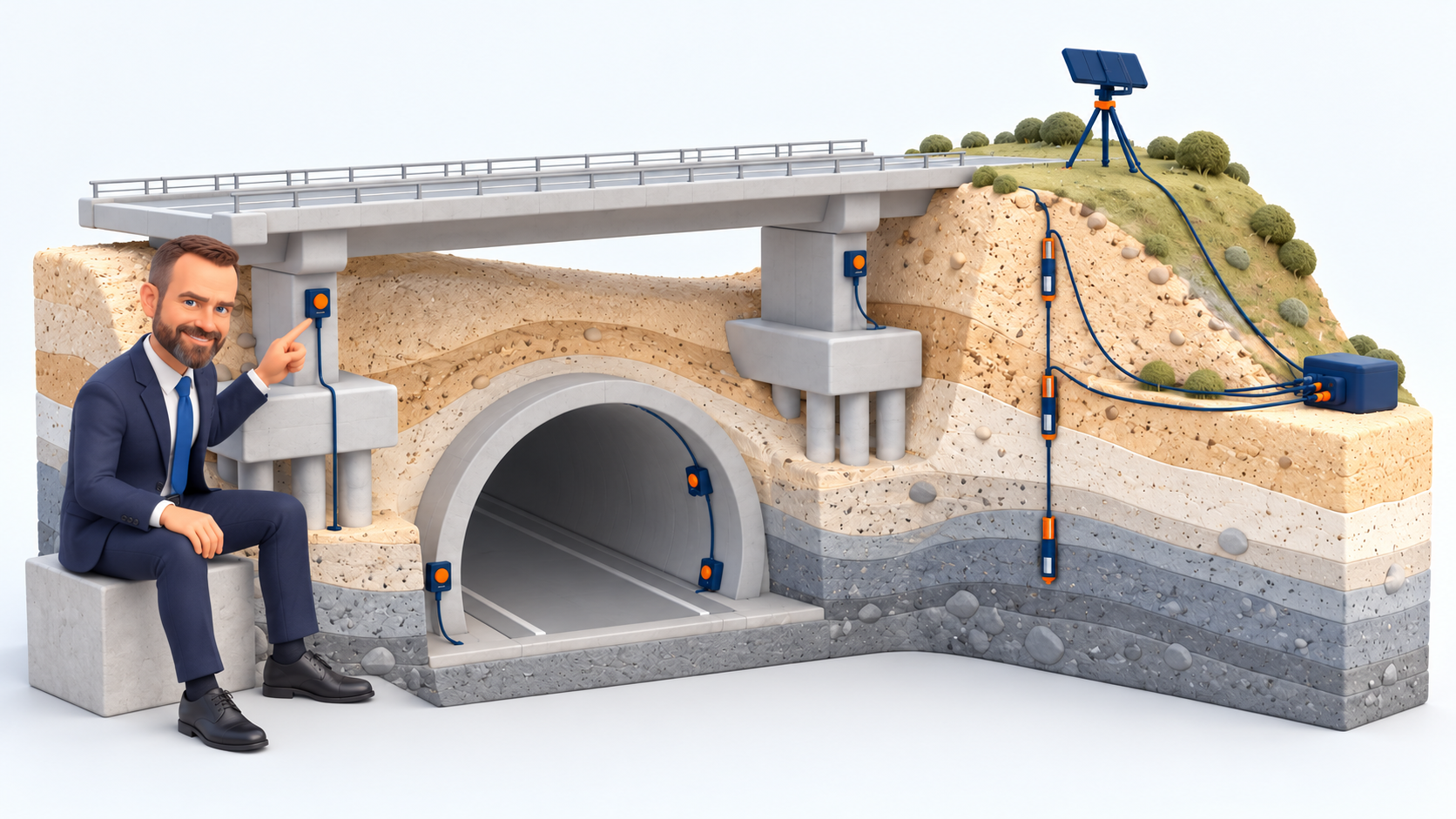
Hexagon signed an agreement on October ninth to acquire Canadian geotechnical and structural analysis software company Rocscience for five hundred and thirty-five million US dollars. The announced enterprise value is on a cash-free and debt-free basis, and closing is expected in the fourth quarter of this year, subject to customary conditions. This is therefore not yet a completed acquisition. Hexagon says Rocscience is approaching fifty million dollars in 2026 revenue, with more than eighty percent recurring revenue and customers in roughly one hundred and twenty-five countries.
The strategic direction is clear: connect geotechnical modelling with radar, sensors, and continuous monitoring. For infrastructure projects, that could create a feedback loop between assumptions about soil or structural behaviour and what is actually measured. However, vendor claims about artificial-intelligence interfaces are not independent evidence of performance. A BIM manager should start with the data architecture: how a calculation scenario maps to a sensor identifier, coordinates, timestamp, threshold, and accountable decision-maker. Teams should also watch the closing of the transaction, licensing changes, and the actual exchange formats that emerge.
Sources retained in the original edition: https://mb.cision.com/Main/387/4406441/4310076.pdf
Buildots benchmarks separate promises from delivery

The second story concerns the reliability of construction planning. On October eighth, the Buildots Intelligence Lab published its inaugural Global Construction Benchmarks report. It is based on anonymised and aggregated data from hundreds of projects across five construction verticals. According to the vendor, only twenty-nine point three percent of activities start on time. Of work already under way, fifty-two point eight percent stays on schedule. Thirty-seven percent of work promised in weekly plans is not delivered. A typical activity finishes five point three weeks late, compared with two point three weeks among top-quartile projects.
Those figures should not automatically be treated as universal market averages. The public material does not provide the complete geography, time period, or composition of the five verticals, and the benchmark comes from a solution provider. Even so, the methodological message is useful: measure the promise, actual start, production rate, and completion separately. A single percent-complete number does not reveal whether the plan is reliable. Before comparing a project with the benchmark, check the project type, work-package granularity, baseline schedule, and the rule used to decide when work has started or finished.
Sources retained in the original edition: https://www.prnewswire.com/news-releases/nearly-40-of-planned-weekly-work-on-construction-sites-isnt-delivered-new-buildots-intelligence-lab-global-benchmarks-report-302902316.html
KTU tests IFC fitness for carbon and circularity

The third and most important story is a prototype from Kaunas University of Technology for assessing IFC data readiness. Announced on October eighth, the method evaluates whether an IFC model contains enough information for a whole-life-carbon inventory and circularity observation. It checks geometry, quantities, materials, other properties, element relationships, and document references. The researchers explicitly warn that the presence of a field does not prove that its value is correct. Completeness and validation must therefore remain separate checks. In the models examined, connection and disassembly data were almost entirely absent.
The work is linked to approaching European requirements. In the university’s summary of the recast Energy Performance of Buildings Directive, whole-life carbon disclosure is expected for new buildings larger than one thousand square metres from 2028, and for all new buildings from 2030. The KTU work is a research prototype, not a production certification tool. But its logic is immediately practical: model quality has to be tested against a defined purpose.
Sources retained in the original edition: https://en.ktu.edu/news/as-new-eu-requirements-approach-ktu-researchers-propose-a-tool-for-assessing-digital-building-models/
Bentley infrastructure awards as case studies

The fourth item comes from Singapore, where Bentley Systems announced the winners of its Year in Infrastructure awards on October seventh. The company received more than three hundred nominations from fifty-three countries and selected winners across twelve categories. Examples include AYESA’s integrated digital workflow for Porto Metro tunnels, Pinnacle Infotech’s digital twin for its Madurai campus, and Wills Bros’ berth construction project at Dublin Port.
These are vendor-selected cases, not an independent comparison of the entire market. Yet a useful sequence appears repeatedly: a shared coordinate and information base, connection of design and reality data, and only then analytics. An artificial-intelligence label does not demonstrate value by itself. When assessing a similar proposal, ask for evidence of the original process, the changed data chain, the measured result, and clear support ownership. Educators can use the projects as case studies if students distinguish supplier narrative from verifiable evidence.
Sources retained in the original edition: https://www.bentley.com/en/news/bentley-systems-announces-winners-of-the-2026-year-in-infrastructure-awards/
IFC as an operational asset information model

The fifth topic is IFC in operations. On October eighth, Ineco announced that its project, IFC as an Asset Information Model, was one of four finalists in the operations category of the buildingSMART International Awards. This is finalist status, not a win. The project focuses on using as-built models for asset management and operations.
The real goal is not to archive an IFC file, but to make it answer operational questions. A facilities user needs to know what an asset is, where it is, its condition, who maintains it, which documents apply, and when it changed. That requires stable identifiers, asset information requirements, and a working update process. Before handover, create a list of priority operational queries and test the required IFC properties and document links against it. The acceptance test should include facilities users, not only model-review specialists.
Sources retained in the original edition: https://www.ineco.com/ineco/en/communication/news/ineco-among-worlds-best-openbim
Reality capture needs provenance, not only geometry

The sixth topic comes from the CIB W seventy-eight conference held in New Delhi from October sixth to eighth. One paper presented a reality-capture digital-twin case study for the historic COEP main building. The team used terrestrial and drone photogrammetry with Bentley iTwin Capture Modeler. The authors identify data integrity, lifecycle management, and high-performance computing as challenges. It is a single case study, not general proof of productivity.
The practical conclusion is simple: a point cloud or photogrammetric mesh is not yet a digital twin. Long-term value depends on coordinates, capture date, uncertainty, version, links to asset objects, and ownership of updates. Reality-capture scopes should request provenance, accuracy, coverage, date, and version metadata alongside geometry. In education, assess more than the visual result: ask whether another person can reproduce, verify, and update it.
Sources retained in the original edition: https://cibw78-conference.org/
Analysis: evidence that data is fit for purpose
Now for the analysis. The KTU prototype shows why BIM quality is shifting from model presence to evidence that data is fit for purpose. Traditional checking often stops at whether a file opens, whether an element has an IFC class, and whether a field is populated. That is not enough for carbon or circularity calculations.
Three levels must be separated. The first is data presence. The second is semantic and numerical validity. The third is fitness for a specific decision. A material name may exist but be ambiguous, outdated, or disconnected from an environmental product declaration. A quantity may be present but calculated with an unsuitable geometry rule. A product identifier may be correct while service life and replacement scenarios are missing. Only at the third level can the model reasonably support a calculation.
The technology consequence is that authoring tools must pass more context: classification, product identity, the basis of quantities, provenance, assumptions, and version. Life-cycle-assessment platforms need dependable links to environmental declarations. Clients must define information requirements before modelling begins, not just before handover. Gaps discovered late become expensive manual recalculation.
From a common-data-environment perspective, marking a file approved is not enough. The CDE should record the check result, ruleset version, data source, exceptions, accountable person, and approval date. Under ISO nineteen thousand six hundred and fifty, this is a question of information requirements, responsibility, and status management. The same field cannot carry the same level of trust during concept design and detailed design.
The opportunity is to find missing information earlier, reduce manual carbon inventories, and hand over more consistent information for operations or reuse. The major risk is optimising a model for field-completion percentages while values remain wrong, defaulted, or disconnected from the selected product. Limits also remain around declaration comparability, data availability, model detail, and accountability.
A BIM manager can take five practical steps. Choose one pilot building and define the minimum carbon and circularity dataset. Separate checks for field presence, value validity, and calculation fitness. Store the ruleset version, exceptions, accountable person, and decision date in the CDE. Reconcile IFC quantities against an independent control calculation. And include provenance, uncertainty, and update scenarios in professional education.
Today’s signal is this: sustainability BIM is not a larger number of populated fields. It is evidence that data is fit for the decision, traceable, and governed throughout its lifecycle.
Watch the edition: https://www.youtube.com/watch?v=2vTUiG6d40I
Watch the original BIMETI Daily BIM Tech Brief — 13 October 2026. Archived edition; review the cited sources for details and later updates.