When Does BIM Become Contractual?
Edition: 9 October 2026 · Category: BIM News
This archived edition preserves the original briefing and its practical analysis. Edition date and underlying announcement dates are different. Product status and reported figures reflect that dated source material, not fresh testing. Conceptual illustrations are original video artwork, not product screenshots.
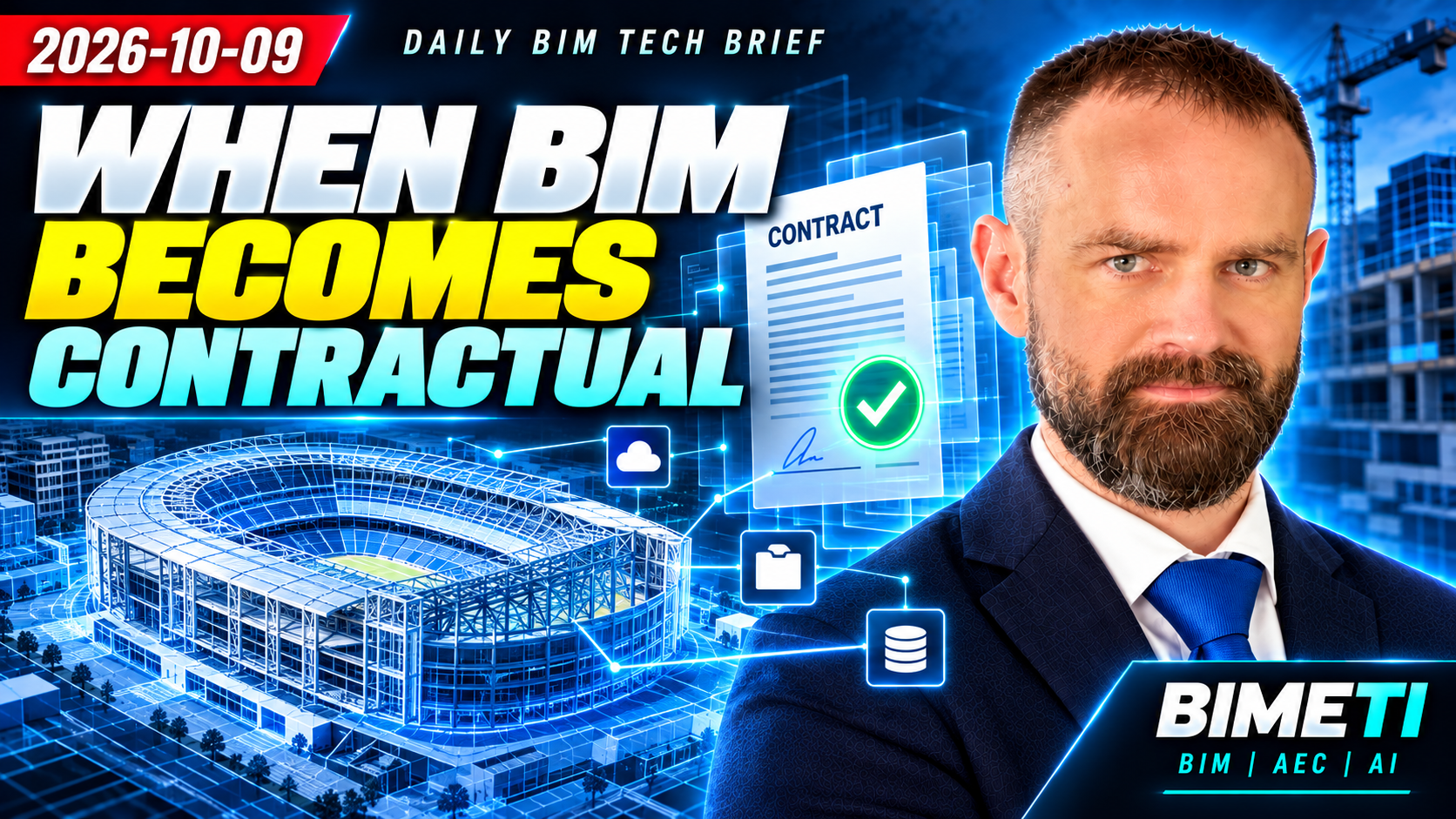
The HKS stadium model enters the contract

The first story comes from the new Huntington Bank Field stadium project in Brook Park, Ohio, in the Cleveland area. On October eighth, Autodesk reported that the architecture practice HKS had included the digital model in the Contract Documents. The project is led by a joint venture between AECOM Hunt and Turner Construction, while project information and teams are connected through Autodesk Forma. Construction started in April twenty twenty-six and opening is planned for twenty twenty-nine. This is a case described by the vendor and project partners, not an independent audit of project outcomes.
The practical lesson for a BIM manager is straightforward: the sentence “the model is contractual” is not enough. The agreement must identify the authoritative container and release, discipline, element scope, required attributes, coordinates, tolerances, approval status, and the rule of precedence when the model conflicts with a drawing or specification. For educators, this is an opportunity to move beyond modelling exercises. Students can receive deliberate conflicts between a model and a PDF and be asked to justify which source governs.
Sources retained in the original edition: https://adsknews.autodesk.com/en/stories/connected-workflows-modernizing-sports-venues/
AEC Data Model pricing: consumption architecture matters

The second story is that pricing for the Autodesk Platform Services AEC Data Model is now in effect. It started on October sixth at midnight coordinated universal time. A limited free tier remains available for experimentation. Eligible product subscriptions provide monthly API capacity when the application belongs to the same Autodesk team as the subscriptions, and capacity is pooled at team level. Under the AEC scheme, Data Out from the AEC Data Model to external storage is charged. Imports, administration and product-to-product exchanges are not charged under this model.
This means BIM integration now has both a technical architecture and a measurable consumption architecture. Poorly arranged teams, excessive full-model exports or unnecessarily frequent synchronisation can become cost and continuity risks. Organisations should check which Autodesk team owns each application and subscription, separate experimental and production client identifiers, monitor Data In and Data Out, set limits and alerts, and test what happens when included capacity is exceeded.
Sources retained in the original edition: https://aps.autodesk.com/blog/data-model-apis-included-subscriptions-plus-flexible-ways-scale
APS passthrough billing: who authorises the cost?
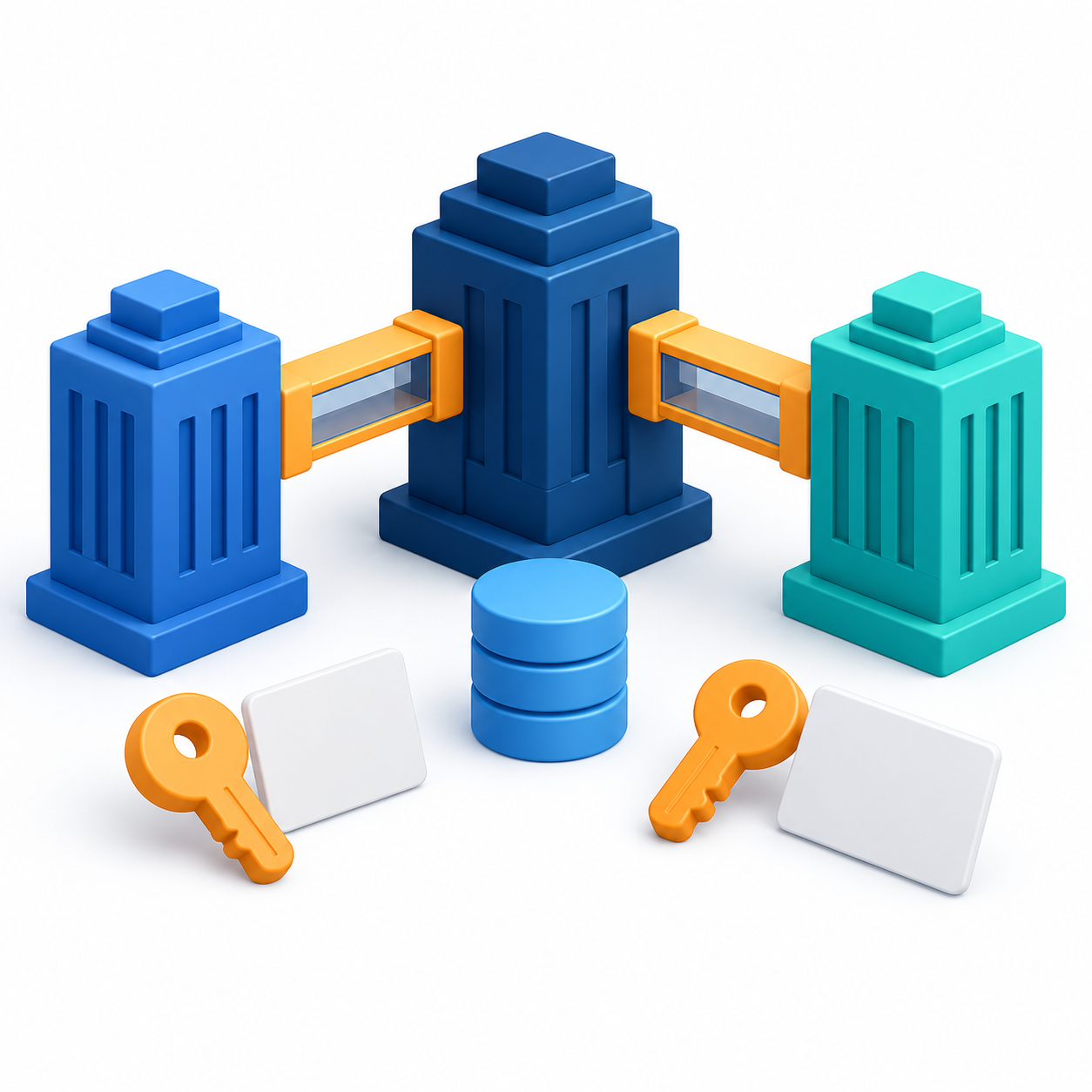
The third story continues the API economics theme. Autodesk announced that passthrough billing is due to launch on October fourteenth. Consumption by an eligible third-party application can then be drawn from the end customer’s Autodesk Platform Services capacity instead of being funded only by the application developer. Both parties must opt in. The initial release requires three-legged OAuth, while pure server-to-server two-legged OAuth is not supported at launch. An existing application also moves through one-way transition states, so this is not a simple setting that can be reversed instantly.
This may reshape pricing for AEC integrations. A high-consumption customer can fund its own API use, but its administrator must understand what is being authorised, who can see consumption and how limits will be governed. Before migration, teams should document the funding model, the three-legged consent flow, customer onboarding, usage reporting, disconnection and the irreversible transition steps. A production client identifier should be changed only after a pilot and an updated commercial agreement.
Sources retained in the original edition: https://aps.autodesk.com/blog/introducing-passthrough-billing-more-flexible-way-manage-api-usage-costs-aps
Schneider Electric and PTC: a signed agreement

The fourth story is one of the year’s largest industrial software transactions. On October fifth, Schneider Electric and PTC announced a definitive agreement. The offer is two hundred and five US dollars in cash for each PTC share, representing an equity value of about twenty-two point six billion dollars and an enterprise value of about twenty-three point seven billion. Closing is expected by the third quarter of twenty twenty-seven, but PTC shareholder and regulatory approvals are still required.
This is a signed but incomplete transaction. The strategic direction is clear: PTC’s CAD, product lifecycle, application lifecycle and service lifecycle data layers would be connected with the Schneider Electric, AVEVA, energy and process environment, and with the planned Cognite context. AEC and digital twin teams should watch concrete product decisions rather than the marketing vision of a single twin. The key questions are identity mapping, permissions, data residency, licensing and support for open formats. No platform architecture should depend on an integration that has not yet been approved and delivered.
Sources retained in the original edition: https://www.ptc.com/en/news/2026/schneider-electric-to-acquire-ptc
European funding for connected building information
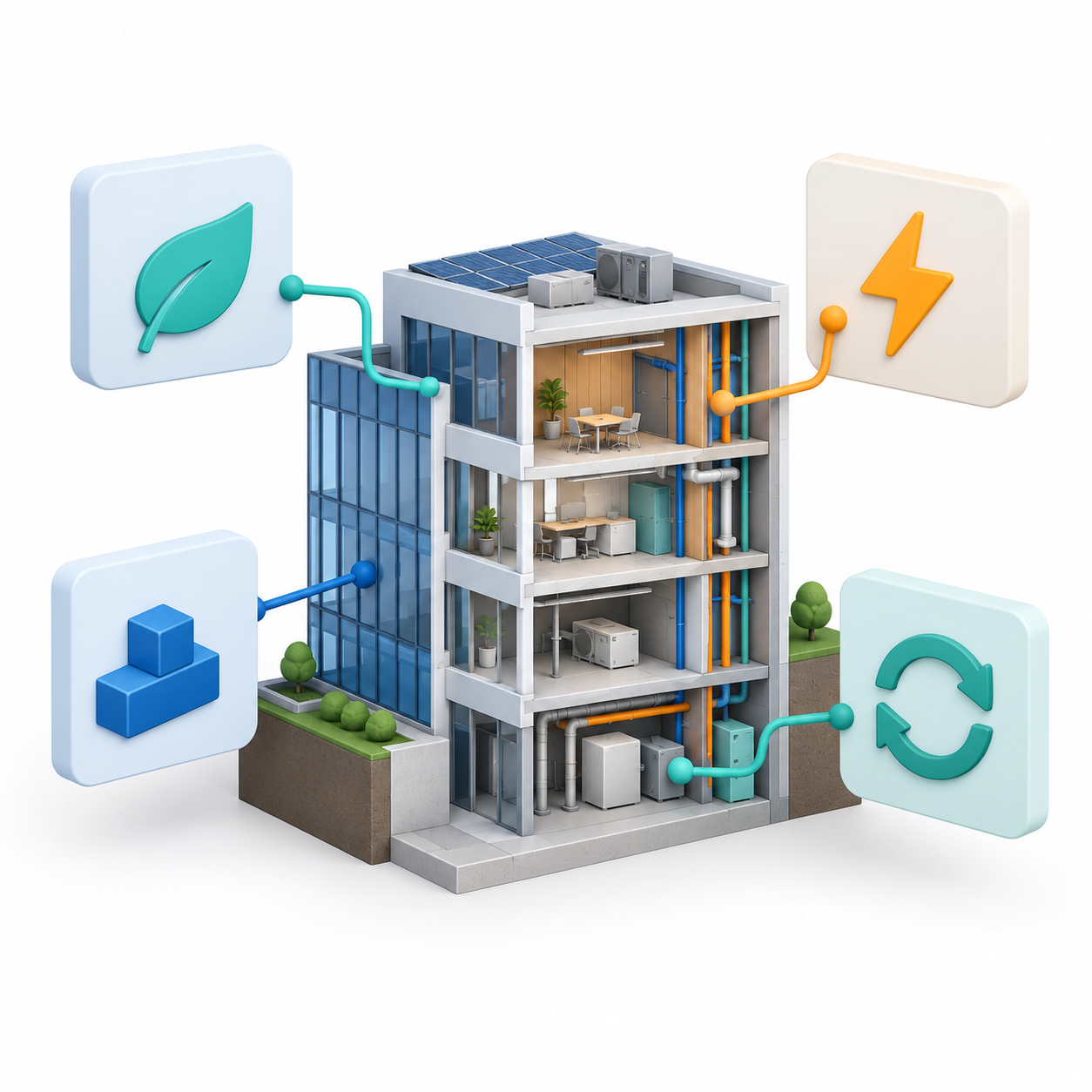
The fifth story comes from the European Commission. In the updated Horizon Europe work programme published on September twenty-ninth, a building digitisation topic carries a total budget of fifteen point seven five million euros, with around five point two five million expected for each project. The target technology readiness level is from six to eight. Projects are expected to integrate whole-life carbon data, Digital Product Passports, Energy Performance Certificates, the Smart Readiness Indicator, renovation passports and digital building logbooks. They must use standards, interoperate with BIM and real-time digital twins, and demonstrate the approach through at least three large-scale pilots.
This is an important signal that BIM, sustainability and operational data are moving toward a shared European information infrastructure. The answer should not be one enormous database. A stronger principle is to federate clearly authoritative sources and their identifiers. BIM managers can map model objects to product passport, carbon, energy and asset-information fields, then decide which data must be immutable, which may be updated and who owns each field. In education, students can trace one BIM object to its product passport, carbon indicator and operational record while identifying the owner of every data point.
Sources retained in the original edition: https://research-and-innovation.ec.europa.eu/funding/funding-opportunities/funding-programmes-and-open-calls/horizon-europe/horizon-europe-work-programmes_en ; https://ec.europa.eu/info/funding-tenders/opportunities/docs/2021-2027/horizon/wp-call/2026-2027/wp-8-climate-energy-and-mobility_horizon-2026-2027_en.pdf
Construction robotics funding targets integrated systems

The sixth story is another topic in the same programme, focused on construction robotics and automation. It has a total budget of twenty point two five million euros, with approximately six point seven five million for each project, again targeting technology readiness levels from six to eight. Proposals must include on-site robotics or automation, at least one three-dimensional printing technique, human-robot safety assessment and at least three demonstrations.
The practical implication is that funding is aimed at integrated site systems rather than isolated laboratory ideas. A BIM model may become the source for a robot’s task, but design geometry is not automatically an execution instruction. The workflow needs coordinate transformations, tolerances, obstacles and work zones, machine paths, safety states, sensor feedback and an approved as-built state. BIM managers should distinguish the design model from the manufacturing or robot-execution model and register every transformation. Students should see how one element moves from BIM into a fabrication path and back into a verified record of actual conditions.
Sources retained in the original edition: https://research-and-innovation.ec.europa.eu/funding/funding-opportunities/funding-programmes-and-open-calls/horizon-europe/horizon-europe-work-programmes_en ; https://ec.europa.eu/info/funding-tenders/opportunities/docs/2021-2027/horizon/wp-call/2026-2027/wp-8-climate-energy-and-mobility_horizon-2026-2027_en.pdf
Japan BIM/CIM and openBIM: distinguish signals from results

The seventh story concerns Japan’s digital infrastructure direction. On October sixth, a vice-minister from Japan’s Ministry of Land, Infrastructure, Transport and Tourism opened the buildingSMART International Summit in Tokyo. The ministry presented BIM and CIM as a core component of i-Construction two point zero and of the digital transformation of buildings and cities. This is a policy direction and an international collaboration signal, not a new mandatory standard or an immediately effective procurement rule.
At the same time, the official buildingSMART news page available during research still contained only the list of twenty-two finalists for the twenty twenty-six openBIM Awards. The ceremony was scheduled for October eighth, but no official winners post had yet appeared. The responsible conclusion is to avoid guessing the winners and wait for primary confirmation. For BIM managers, the Japanese signal matters because it joins infrastructure BIM with urban data. For educators, it is a useful example of the difference between a policy direction, an event statement, a technical standard and a legal requirement.
Sources retained in the original edition: https://www.mlit.go.jp/page/kanbo01_hy_011143.html ; https://www.buildingsmart.org/buildingsmart-international-announces-finalists-for-the-2026-openbim-awards/
Analysis: prove the authority of a model release
Today’s analysis asks what a contractual BIM model really means. In a conventional process, the model often acts as a coordination tool, while legal precedence remains with drawings and specifications. When a model enters the Contract Documents, it becomes more than a convenient view. It can become a source of rights, obligations, quantities and decisions. This can reduce rework and communicate design intent more clearly, but only when the contract language and information management system define the boundaries of the model precisely.
The greatest opportunity is to connect geometry, properties, quantities, coordination decisions and change history through one approved information release. Contractors can understand design intent more accurately, owners can receive a traceable decision chain, and operations teams can gain a clearer foundation for asset information. Contractual status can also encourage earlier multidisciplinary coordination, because an undefined element is no longer merely a visual imperfection.
The largest risk is the false belief that a cloud model always contains one obvious truth. A federation may contain several sources, linked models and different release times. The latest version visible today is not necessarily the contractual release. An exported IFC file may not reproduce every property in the authoring source, and a review platform may show a generated view rather than the authoritative container itself. A conflict between the model, a PDF, a specification and a bill of quantities is therefore a contract question, not merely a technical error.
Five layers must be governed. First is contractual scope: the disciplines, elements, properties and lifecycle stage included. Second is the authoritative release: container identifier, revision, status, date and checksum. Third is the interpretation rule: units, coordinates, classification, level of information need and tolerances. Fourth is precedence: what governs when the model conflicts with a drawing, specification or quantity. Fifth is the evidence chain: who checked and approved the release, which exceptions were accepted and how the release was archived.
The common data environment must preserve an immutable contractual moment instead of only presenting the latest state. Each release needs a manifest listing files or containers, checksums, schemas, the coordinate system, linked documents, validation reports, exceptions and approvers. ISO nineteen six fifty processes help manage states and releases, while IDS can validate some alphanumeric requirements. But neither a process standard nor an automated check determines the legal precedence of a specific project model. That must be defined by the contract and applicable jurisdiction.
What should organisations do now? First, prepare a one-page contractual model matrix covering disciplines, elements, properties, tolerances, states and precedence rules. Second, generate an immutable manifest for every release, including container identifiers, revisions, checksums, IFC schema, coordinates and approvers. Third, create a reference conflict set across the model, PDF, specification and quantities, and test whether different participants reach the same decision. Fourth, archive contractual releases in an open format together with the original, export settings, viewing method and quality report. Fifth, pilot the method on one discipline and one delivery stage before applying it to the whole project.
Today’s conclusion is that a model does not become a trustworthy contractual document because one sentence says so. It becomes trustworthy when every participant can prove which information was authoritative, in which release, under which tolerances, who approved it and how a conflict must be resolved.
Watch the edition: https://www.youtube.com/watch?v=_ghqWD2Fd3k
Watch the original BIMETI Daily BIM Tech Brief — 9 October 2026. Archived edition; review the cited sources for details and later updates.